Things to do in Huining
Explore top experiences
Top 10 attractions in Huining

Huining Red Army Meeting Site
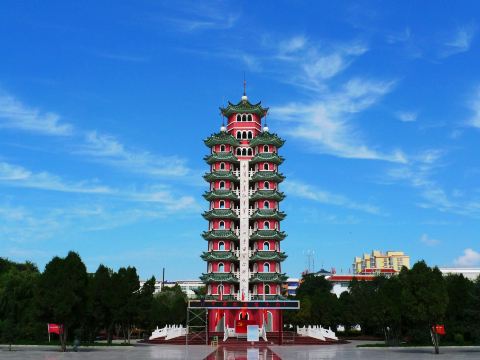
The former site of Huining Huishi of the Red Army is located in the center of the county, covering an area of 42,600 square meters. It is a national key cultural relics protection unit, one of the first 100 patriotic education demonstration bases in the country, one of the first 50 national integrity education bases, and one of the national key cultural relics protection units. Safety education base and national defense education base, national primary and secondary school student research and practice education base. In October 1936, the First, Second, and Fourth Fronts of the Chinese Workers' and Peasants' Red Army joined forces in Huining, Gansu Province. It was a sign of the victory of the Long March, a forward position in the national war of resistance, a model of great unity of revolutionary forces, and a turning point for the Chinese revolution to victory.Huining · 207m from downtown

Red Army Long March Victory Memorial Hall
The Huining Red Army Long March Victory Memorial Hall is a thematic memorial hall with the theme of commemorating the great historical event of the Red Army's three main forces successfully meeting in Huining and the victory of the Long March. It is the only memorial hall in the country that fully reflects the history of the Red Army's Long March. After its completion in October 2006, it became another landmark building in the Red Army Huining Meeting Site. The design and construction of the Huining Red Army Long March Victory Memorial Hall combines antique and modern architecture. The layout is centered on the Meeting Tower and the Meeting Building is a reference. It is located on the left side of the Red Army Huining Meeting Site. The main body of the memorial hall is a two-story, partially three-story, semi-underground frame structure.Huining · 212m from downtown


Gansu Provincial Museum
Gansu Provincial Museum is a large comprehensive museum centered on the civilization of the Silk Road. Located at a strategic point along the Silk Road and a convergence zone of Han and Tibetan cultures, its collections embody the diverse characteristics of the Central Plains, Western Regions, and the Tibetan Plateau. The three treasured artifacts—the Galloping Bronze Horse, the mural brick of a courier, and the painted pottery vase with a human-head-shaped mouth—serve as iconic representations of the museum. The museum has three floors, featuring permanent exhibitions on themes such as the civilization of the Silk Road, Buddhist art of Gansu, painted pottery of Gansu, paleontological fossils, and revolutionary Gansu. The Silk Road civilization exhibition on the second floor is the museum's centerpiece: the bronze galloping horse unearthed in 1969 from the Leitai Han tomb in Wuwei is displayed here. The horse has three hooves in the air and one stepping on a flying bird, standing steadily on a single hoof. Its image is now the symbol of Chinese tourism. In the same hall, the mural brick depicting a courier from the Wei-Jin tombs in Jiayuguan shows a messenger galloping on horseback, notably without a mouth, symbolizing the need for couriers to "keep their mouths shut." This pattern was later adopted as the emblem of China Post. The exhibition also features a procession of chariots and horses excavated from the same tomb as the bronze horse, along with Han and Tang dynasty silk textiles, gold and silver artifacts, making the prosperity of Silk Road trade vividly tangible. The Buddhist art exhibition hall on the third floor features replicas of caves from the Mogao Grottoes and Maijishan Grottoes, alongside statues, ritual objects, white pagodas, and prayer wheels from both Han and Tibetan Buddhism. Stepping into the hall feels like entering a temple, and this harmonious blend of Han and Tibetan styles is rarely seen elsewhere. On the same floor, the painted pottery exhibition showcases ceramics from cultures such as Dadiwan, Yangshao, and Majiayao, with intricate and fluid patterns like spiral and sawtooth designs. Among them, the painted pottery bottle with a human-head-shaped spout unearthed at Dadiwan in Qin'an, which integrates facial sculpture with the pottery vessel, is a highly popular exhibit. If you're interested in natural history, the paleontological fossils exhibition hall features the impressive skeleton of the Yellow River ancient elephant unearthed in Heshui, and the dinosaur fossils and reconstructed models are also popular with children. The revolutionary Gansu exhibition hall showcases historical artifacts and materials from periods such as the Nanliang base area and the Shaan-Gan-Ning border region, narrating the modern history of this land. The museum houses a large quantity of exhibits, and even a quick tour would take half a day. It's recommended to start with the Silk Road exhibition on the second floor, then proceed to the third floor for Buddhist art and painted pottery, following a logical route. In the exhibition halls, you can scan to listen to the audio guide, and at certain times, volunteers also provide guided explanations.China · Lanzhou

Lanzhou Old Street
Lanzhou Old Street is located in the center of Lanzhou city, gathers Chinese branded products, nightlife, trendy fashion brands, retail centers, experiential businesses, catering and entertainment, leading the trend and creating a place for eating, drinking, fun and entertainment in Lanzhou.China · Lanzhou

Zhongshan Bridge
Zhongshan Bridge, also known as the Lanzhou Yellow River Iron Bridge, spans the Yellow River with White Pagoda Mountain to its north and serves as a city landmark of Lanzhou. Completed in the late Qing Dynasty, it was built by the German firm Telge & Schroeter. The bridge materials, including steel beams and cement, were shipped from Germany across the ocean and then transported to Lanzhou via railway and horse-drawn carriage. It is one of the earliest permanent bridges built across the Yellow River in Lanzhou's history. It was later renamed Zhongshan Bridge in memory of Dr. Sun Yat-sen, a name that remains in use today. The bridge is over 200m long, and its gray-black steel truss structure is simple and substantial. The several arched steel ribs added above the bridge body during reinforcement in the 1950s give the entire structure a more imposing appearance. Today, the iron bridge is open only to pedestrians. Walking onto the bridge deck, you can see the Yellow River flowing slowly eastward beneath your feet. On the south bank lies the lush Binhe Road, while the north bank is home to White Pagoda Mountain Park. Climbing to the top of the mountain and looking back, the view of the iron bridge, the Yellow River, and the streetscape on both banks framed together is particularly beautiful. People often line up to take photos in front of the golden "Zhongshan Bridge" inscription at the south end of the bridge. In the pavilion on the east side of the south bridgehead stands a Ming Dynasty "General Pillar," a relic from the earlier Zhenyuan Floating Bridge that is easy to miss if you just walk past. After nightfall, the iron bridge offers a different scene: the bridge's colorful lights turn on, and the entire outline of the bridge is clearly illuminated. On one side are the bustling lights of Binhe Road, and on the other are the lights shining on the mountain, making it a great place to experience and photograph the night view of Lanzhou.China · Lanzhou

Baoji Bronze Ware Museum
The Baoji Bronzeware Museum is in the Chinese Shi-ku Garden of Baoji City, "the hometown of bronzeware." The museum has four exhibition halls, and Halls 1 and 2 are the focuses of the tour. The museum displays high quality bronzeware, such as the Hu gui from the period of King Li of Zhou and the treasures of Qin Duke Bo. The He zun, which is inscribed with the words "Here in China I dwell," is kept here.China · Baoji

Tengger Desert
The Tengger Desert is located in the southwest of Alxa Left Banner in Inner Mongolia Autonomous Region and the border in the central part of Gansu Province. Here you can experience starry sky camping in the Tengger Desert, ride a camel in the sandy sea, or ride an off-road vehicle in the desert to feel the passion. The sand peaks of the Tengger Desert are magnificent, the sand grains are fine and smooth, and the color is golden and shiny. Walking into the depths of the desert, in addition to the golden sand sea, there are many lakes. From a distance, the piles of salt chimneys by the lake are like ice and snow, and the lake is glowing with silver light, like a sand sea glaciers.China · Zhongwei

Shi-ku Garden in China
Shi-ku Garden in Chinais located on Shigu Mountain on the south bank of the Wei River in Baoji, to the north it overlooks the Wei River, to the east it borders the Yinxiang River, and to the south it adjoins Tiantai Mountain National Forest Park. Legend has it that the pre‑Qin stone drums unearthed in the early Tang were found in this area. The ten granite, drum‑shaped stones are inscribed with stone drum script, a writing that follows bronze script and anticipates small seal script. The Tang writer Han Yu wrote the "Song of the stone drums" to praise their value, and the original artifacts are now kept at The Palace Museum in Beijing, soShigu Mountaintook its name from this association. The park spreads along the mountain slope, integrating site conservation, bronze exhibitions, stone drum culture displays, garden sightseeing, and archaeological research into a cultural ecology park. At a high point in the park, the Shigu Pavilion is the landmark building. Modeled on Qin and Han styles, its outer‑five, inner‑nine tiering is especially striking, and from the pavilion you can look down on the urban areas on both banks of the Wei River. At the foot of the mountain, the Baoji Bronze Ware Museum houses Western Zhou bronze masterpieces such as the He zun and the Lai pan. The museum and the Shigu Pavilion, one high and one low, form the main tour route. You can also walk past the Zhou Culture Wall, the Han character gallery, the plaza for heaven worship and ancestor veneration, and the Shigu Mountain corridor bridge. At night, the Shigu Pavilion and the corridor bridge are illuminated, and the park takes on a different atmosphere.China · Baoji

Ganjia Grassland
Ganjia Grassland is an open alpine meadow and a traditional pasture where herders have grazed their livestock for generations. In midsummer, the grassland is lush green, with wildflowers spreading along the gentle slopes and herds of cattle and sheep scattered throughout. Compared to Sangke Grassland near the county seat, it receives fewer tourists and retains the more primitive and tranquil appearance of an alpine pasture. The grassland's distinctiveness largely comes from the Baishiya stretching across the end of the pasture — a gray-white cliff stretching over 10 km that stands like a screen above the greenery, with Baishiya Temple located at its foot. The Yangqu River and Yangla River meander across the grassland. The Bajiao Ancient City, built on the terrace where the Yangqu and Yangla rivers meet, is named for its eight corners. Ascend the viewing platform to take in the panoramic view of the ancient city, surrounding highland barley fields, and pastures. The grassland covers a large area with scattered attractions. Baishiya, Bajiao Ancient City, and Zuohai Temple are located in different directions, making it suitable for a self-drive or car charter tour along the route.China · Xiahe

White Pagoda Mountain Park
White Pagoda Mountain Parkis located on the north bank of the Yellow River in downtown Lanzhou. The main entrance is right at the north end of Zhongshan Bridge; you can enter the mountain immediately after crossing the bridge. It is named after the white pagoda on the mountaintop. The existing white pagoda was rebuilt during the Ming Dynasty. It is a seven-story, octagonal structure about 17 m high. Its body is pure white, making it one of the iconic ancient pagodas in Lanzhou. The temple on the mountaintop is commonly known as White Pagoda Temple. It was renamed Ci'en Temple after being expanded in the Qing Dynasty. Among the three treasures of the mountain passed down by local folklore, old artifacts such as the Elephant Skin Drum and the Bronze Bell are still preserved in the temple today. The entire mountain has an elevation of about 1,700 m, but the relative height difference from the Yellow River valley below is only about 200 m, so climbing the stone steps is not strenuous. The three-tiered architectural complex on the front of the mountain is built layer by layer along the terrain, with archways, halls, and corridors distributed in a staggered manner. Many of the old components came from houses demolished in the old city. As you climb the steps, you will pass the old archway inscribed with "Fenglin Xiangniao" and courtyards such as the Sanguan Hall and Luohan Hall. The path is shaded by trees, and along the way, you will occasionally encounter small stalls selling local handicrafts such as carved gourds and Yellow River stone carvings. Looking back from the mountaintop, the Yellow River flows through the city, and the buildings on both banks are lined up in rows, offering a panoramic view of the city. If you reach the top in the evening, you can watch the lights turn on one by one, which is a great time to photograph the night view of the Yellow River.China · Lanzhou
Free things to do in Huining
Huining Red Army Meeting Site
Huining · 207m from downtownRed Army Long March Victory Memorial Hall
Huining · 212m from downtownGansu Provincial Museum
China · LanzhouLanzhou Old Street
China · LanzhouZhongshan Bridge
China · LanzhouBaoji Bronze Ware Museum
China · BaojiTengger Desert
China · ZhongweiShi-ku Garden in China
China · BaojiGanjia Grassland
China · XiaheWhite Pagoda Mountain Park
China · Lanzhou
What travelers say about Huining

netcat12 August 2020
4.0
The Huining Red Army Meeting Site is located on Huining Road, Huining Town, Huining County. The site is 110 meters wide from east to west and 400.6 meters long from north to south, with a total area of about 44,718 square meters. It is a revolutionary site expanded to commemorate the successful meeting of the First, Second and Fourth Front Armies of the Chinese Workers' and Peasants' Red Army. The main buildings of the meeting site include: the Red Army Meeting Building and the ancient city wall, the Red Army Meeting Party Site (Confucian Temple Dacheng Hall), the Three Armies Meeting Memorial Tower, the Huining Red Army Meeting Revolutionary Relics Exhibition Hall, and the Red Army Long March Generals Stele Forest.
Huining Red Army Meeting Site

M14***996 October 2026
5.0
Lina, the lecturer at the Gambo Museum, is exceptionally skilled. During the two-hour learning experience, she demonstrated a thorough understanding of the chronological order and comparative analysis of the artifacts, meticulously integrating historical evolution with everyday life. I look forward to the completion of the new Gambo Museum and visiting it again next time.
Gansu Provincial Museum

大叔的星辰大海!21 April 2026
4.0
Lanzhou Old Street is quite close to the Yellow River Tower. We walked there after visiting the Yellow River Tower. The old street area isn't small, and it feels like a newly built commercial district. In the afternoon during the off-season, there were very few people. I wonder if it will be more crowded at night? The shops are mainly restaurants, plus souvenir shops. If you're passing by, you can check it out!
Lanzhou Old Street

Jamie Ning20 July 2026
4.0
Before coming to Lanzhou, I had no idea what this bridge was like.
I arrived around 3 PM; the sun was still blazing, and the iron railings on the bridge felt hot to the touch. This iron bridge, built in 1909, spans the Yellow River, looking sturdy yet silent. Standing on the bridge, the Yellow River surged beneath my feet, carrying the scent of silt. Speedboats darted out from under the arches, splashing up waves, and children on the bank screamed excitedly—their jubilation was unstoppable.
I didn't rush up the mountain; instead, I found a seat at a teahouse under the bridge. I ordered a cup of "Sanpaotai" (a type of local tea), 15 yuan, with refills. The bamboo chair was a bit old, but just the right amount of comfortable. Several local old men around me were cracking sunflower seeds and playing chess, occasionally glancing up at the river and saying, "The water's risen again." That relaxed feeling is rare in tourist spots.
You absolutely must try the Sanpaotai at the teahouse. Don't rush; sit for at least half an hour, just gazing at the river and daydreaming—that's the real deal.
The cruise ticket is only a few dozen yuan, not expensive at all, and worth experiencing the view from under the bridge.
Speedboats and sheepskin rafts are available on the shore; thrill-seekers can give them a try.
Regarding photography: the "Zhongshan Bridge" stone monument on the south side of the bridge is a classic spot for photos.
Take your time; although the sun is strong 🌞, the river breeze is very pleasant.
Zhongshan Bridge

blu***hh15 August 2026
5.0
The teacher's explanations made our visit truly meaningful. The explanations were very comprehensive and detailed; I'll need to review some of the points later. I really liked the architectural style of the Baoji Bronze Museum; it was definitely worth the long journey.
Baoji Bronze Ware Museum

绿色大白鲨1 September 2025
5.0
The Tengger Desert is one of the famous scenic spots in Zhongwei, Ningxia. It is very close to Shapotou and has beautiful and charming scenery. It is very suitable for family travel. Riding a camel in the desert feels very comfortable and is many times better than the experience of gravel roads. The thrilling desert assault car and the fun of sliding down the sand on a plastic board from the slope are also very enjoyable. Overall, the desert play experience is still good. Pay attention to sun protection and safety, stay with your children all the time, capture the beautiful and happy moments, and embrace nature.
Tengger Desert

首席监理30 May 2022
4.0
The Chinese Stone Drum Park is one of the key tourist and cultural scenic spots in Baoji City, Shaanxi Province. It is located on the Stone Drum Mountain, where the Stone Drum, which was praised by Kang Youwei as "China's No. 1 Antiquity", was unearthed. It is adjacent to Yinxiang River in the east, Jifeng Mountain, the main peak of Qinling Mountains in the south, the urban area in the west, and the Weihe River in the north. It covers an area of more than 500 acres and has a total construction area of 47,000 square meters. It is a cultural ecological park with the theme of Zhou and Qin history and culture. There are five major areas, Baoji Bronze Museum, Chencang Stone Drum Pavilion, Qin Culture Square, Stone Drum Square, and Jinshi Garden, which integrate site protection, bronze exhibition, stone drum culture display, garden sightseeing, archaeological research and leisure and entertainment, and fully display the profound history and culture of Baoji as the birthplace of Zhou and Qin culture.
Through the protection and shaping of natural landscapes, the park has become a collection of the five characteristics of Baoji, Shaanxi, namely, mountain, water, forest, plateau, and city. Through the integration and reproduction of Zhou and Qin history, the park has become a microcosm of ancestral culture and a charming place with both natural and humanistic characteristics. The two iconic buildings of the China Stone Drum Park, Chencang Stone Drum Pavilion and Baoji Bronze Museum, have become the new city coordinates of Baoji.
Shi-ku Garden in China

晚霞风车24 August 2023
5.0
Gangjia Grassland is located in Gangjia Township, Xiahe, Gannan Tibetan Autonomous Prefecture, Gansu Province, 33 kilometers north of Xiahe County, and is directly accessible by road. Gangjia Grassland is a meadow grassland, vast and boundless, with an average altitude of more than 3,000 meters. It is one of the main animal husbandry bases in Gannan Tibetan Autonomous Prefecture. There is a reception desk at the Muyun Tent Camp, which prepares fresh milk tea, tsampa, Tibetan buns, hand-pulled mutton and other Tibetan specialties for tourists. It also prepares grassland tourism programs such as horses, yaks, shooting bonfire parties, etc. for tourists. Visitors can fully experience the mysterious and simple Tibetan customs here.
Ganjia Grassland

一直在路上的猫14 October 2026
5.0
Lanzhou Baitashan Park | A Landmark in Northern Lanzhou
Location: North bank of the Yellow River, north end of Zhongshan Bridge; admission is free.
Origin: Named after the White Pagoda Temple atop the mountain. The pagoda was originally built in the Yuan Dynasty, but the existing structure is a Ming Dynasty reconstruction. Seven stories high, octagonal, and entirely white, it is a symbol of Lanzhou. The entire park is built along the mountainside, comprising three ancient architectural complexes. Red-columned pavilions and towers with flying eaves cascade down the slope, surrounded by lush greenery, creating a rare mountain forest garden atmosphere in Northwest China.
Attractions:
1. White Pagoda Temple on the mountaintop: The core attraction. From here, you can enjoy a panoramic view of the Yellow River, Zhongshan Bridge, and the entire city of Lanzhou. The sunset and night views are superb.
2. Two ways to experience the area:
◦ If you have plenty of energy: Hike up the mountain along the stone steps and leisurely explore the ancient buildings;
◦ If you have limited energy (like you did this time): Explore the area at the foot of the mountain and near the bridge. Taking photos of the White Pagoda in the distance and Zhongshan Bridge together is also very beautiful; if you don't want to walk, you can take the Yellow River cable car directly to the mountainside, saving you the trouble of climbing (cable car fee is separate).
3. The Yellow River wharf is located at the foot of the mountain, where you can take a sheepskin raft or a Yellow River cruise;
The view of White Pagoda Mountain Park from the opposite bank of Zhongshan Bridge in the evening is exceptionally beautiful; a must-see when visiting Lanzhou.
White Pagoda Mountain Park


