
Things to do in Jingning
Explore top experiences
Top 10 attractions in Jingning


Shapotou Scenic Area
The scenic spot is located 16 kilometers west of Zhongwei City, Ningxia, on the southeastern edge of the Tengger Desert. The scenic spot has successively won honors such as "the first batch of national 5A-level tourist attractions", "the top 500 global environmental protection units", and "the first batch of national tourism standardization demonstration units". The three major cultural elements of the scenic area include the "Yellow River Culture" based on the intangible cultural heritage sheepskin rafts, the "Desert Culture" based on straw grids and Desert Legend Park, and the "Starry Sky Culture" based on the Desert Star Hotel. The tourism resources of these three elements have created a unique and magnificent landscape of "sunset over the long river and starry sky in the desert". The "six major ways to play" are highly praised and loved by tourists. Among them, the Yellow River projects include sheepskin rafting, Huangtengda, Yellow River speedboat, drift boat, passionate sandboarding and high-altitude bungee jumping, etc. The desert projects include Desert Camel, Desert Flying (Stepping into the Blue Clouds), and Sand Sea. Surfing, etc., starry sky projects include stargazing lectures, meteor feasts, sand therapy experiences, star cakes and other special products. In addition, there are also privately customized products for hiking, desert expansion, and educational and entertaining study experiences. The scenic area not only has diverse cultural elements and fun project experiences, but also multi-level accommodation experiences waiting for you: the butler-style Diamond Hotel, the quiet Desert Star Hotel for stargazing, the quiet Yellow River Courtyard in the bustling city, and finally the economical and affordable business-style Tourist Service Center Hotel and other differentiated tourist accommodations for you to choose from.China · Zhongwei
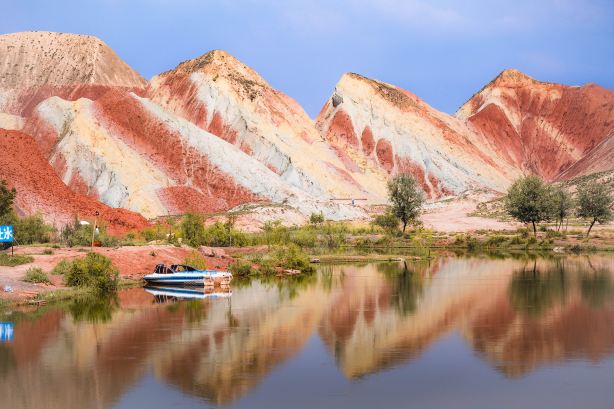
Lanzhou Danxia Geological Park
Lanzhou Danxia Geological Park is a key cultural tourism project in Gansu Province and a comprehensive cultural tourism initiative prioritized by the Lanzhou Municipal Committee and Government. Located by the Yellow River, the park is just 13 km from downtown Lanzhou and 30 km from Lanzhou Zhongchuan International Airport, making it one of the closest Danxia landform clusters to a major urban center in China. With a total planned area of 400 sq km and a core visiting area of 25 sq km in its first phase, it ranks among the largest discovered landscapes of its kind in the country. The park primarily features red mountain bay formations, along with spectacular Danxia cliffs, isolated peaks, secluded valleys, narrow gorges, and balancing rocks. Its colorful mountains set against winding waterways create a masterpiece of Danxia landform scenery. The attraction features seven viewing platforms showcasing the Danxia landforms: Silk Road Glow, Silk Road Eagle, Flying Apsaras Exploration, Nine-Colored Danxia, Danxia Reflecting Sky, Emerald Peaks Rippling Sky, and Danxia Summit Scenic View. It also includes the Ancient Silk Road Gateway, Shajing Tribe Cultural Square, Desert Bells Scenic Boulevard, and a 2,550m Danxia boardwalk viewing area. As a key cultural tourism project in the province, Lanzhou Danxia Geological Park adheres to the principles of "ecological protection, green development, preserving original features, and moderate development." Leveraging Lanzhou's unique resource advantages and focusing on the domestic tourism market, it aims to cultivate new growth drivers for Lanzhou's cultural tourism industry and establish a new highland for cultural tourism in the city.China · Yongdeng

Zha Ga Na
Zhagana, also known as Zhagala, is located in Diebu County, Gannan Tibetan Autonomous Prefecture. It is a small Tibetan village surrounded by a circle of pretty cliffs. It has beautiful and magical scenery and is one of the most beautiful places in the entire Gannan Tibetan area. The ancient wooden Tibetan houses in the village are built along the mountain, and the locals work quietly and simply between the hillsides and rivers, forming a beautiful pastoral scenery. Whether you want to sightsee, take photos, or visit the traditional life of the simple Tibetan people, this is a wonderful place that you cannot miss. Zhagana is located in the valley of Yiwa Township, Diebu County. It takes about 1 hour to drive from Diebu County and about 2 hours from Langmusi. Zhagana is suitable for visiting in July and August, when the grassland is green and the scenery is beautiful. Most tourists come from Langmusi when they take the Gannan-Sichuanbei route. The usual time to visit is to arrive in the afternoon of the same day and take a leisurely stroll in the village to enjoy the beautiful scenery. Stay in a Tibetan homestay for one night, and leave the next morning after taking pictures of the early morning clouds and sunrise. In addition, there is a two-day hiking route in the back mountain of Zhagana, where you can rent a horse in the village or walk there. Zhagana Village is divided into four small villages, from bottom to top, they are Dongwa Village, Yeri Village, Dari Village and Daiba Village. Dongwa Village and Daiba Village are about 5 kilometers apart, and there is a winding road connecting the four villages. You can walk or drive to visit and take photos one by one. It takes about 1 hour to walk from the bottom to the top. Driving in from the entrance of the village, the first place you arrive at is Dongwa Village at the foot of the mountain. There is a big stone here called Dashimen. The small hillside next to Dashimen is a good place for taking photos. Here you can look up and take pictures of the beautiful scenery of the village built along the mountain. The back of the village is wrapped by cliffs, and there is a Tibetan Buddhist temple on the top of the village. The scenery is fantastic and beautiful. Dongwa Village has a large population and is also a good place to stay. You can book a stay at a farmhouse here, and then walk or drive to several higher villages to play. It takes about 1 hour to walk to the higher place. Going up the mountain along the road, you will reach Yeri Village. Next to Yeri Village is a vast barley field where you can often see Tibetans busy in the fields. The scene is peaceful and simple. In addition, there is a house in Yeri Village where the famous traveler Joseph Locke once lived for more than a year, but now it can only be visited from the outside. Continue to go up, after passing Dari Village, there is a viewing platform with a wide view, suitable for taking bird's-eye views of the whole village. You can see the whole village and the fantastic rock wall behind. All the houses are old wooden roofs and earthen walls, which look simple and peaceful. Under the cliff, they form a beautiful picture scroll, which is also a wonderful place to take good photos. After taking the panoramic view, you can go back to Dongwa Village for accommodation. Daiba Village is relatively remote and there are fewer scenery to see, so you can skip it. In addition to taking photos in the afternoon, there are many other things to look forward to in Zhagana. Every morning, there are almost clouds and mists between the rock walls on the mountain, and the starry sky is beautiful and brilliant at night when the lights are off, which are good opportunities for taking photos. If you have enough time, you can also take 1-2 hours to climb the back mountain of Dongwa Village to see the temple on the top of the mountain. The houses you pass by along the way are all ancient buildings, and the wooden wedge-rivet structure is even more ancient and peculiar. If you are lucky, you can meet kind locals and be invited to their homes to taste traditional food such as tsampa butter tea and experience the simple enthusiasm of the locals. In addition, there is a two-day hiking route behind the village, which leads to the rarely visited lakes and stone forests with pristine and beautiful scenery. However, this route is only suitable for outdoor enthusiasts and requires camping for one night. When walking this route, you can rent a horse in the village and find a horseman to lead the way. Generally, a horse costs about 150 yuan a day.China · Diebu

Liupan Mountain National Forest Park
Liupanshan National Forest Park is located in Jingheyuan Town in Jingyuan County, Guyuan City. The main attractions in the park include Xiaonanchuan, Liangdian Gorge and Erlong River. Entering through the main gate, Liangdian Gorge is to the north, while Erlong River is to the south and Xiaonanchuan lies between them. There is also an ecological museum and botanical garden. Liangdian Gorge stretches several kilometers long and has a clear stream at the very bottom. Climbing to the main peak, Mingang Mountain, hikers are treated to a sight of an seemingly infinite sea of clouds.Jingyuan · 55.9 km from Jingning

Qingmuchuan Ancient Town
Picturesque Qingmuchuan Ancient Town has a long history. The Qiang and Han people intermingled and lived peaceably together here. The area gradually prospered during the Ming dynasty, and most of the residences here were built during the Ming and Qing dynasties (1368-1912). A river cuts through the ancient town, and the people here live a carefree and leisurely life. The town's Wei Family Mansion was built during the Republican Era (1912-1949), and the Qu, Wei, Zhao, and Tu ancestral halls were built during the Ming and Qing dynasties.China · Ningqiang

Kongtong Mountain
Kongtong Mountain has a long history and rich cultural connotations. It is the holy place where the ancestor of humanities, Xuanyuan Huangdi, climbed the mountain and asked questions. According to legend, Emperor Xuanyuan visited the western frontier after his achievements and personally visited Kongtong Mountain to ask Guangchengzi, who lived in seclusion in Kongtong Mountain, for advice on how to govern the country and maintain health. Kongtong became famous forever. Kongtong is the cradle of religion where the three religions unite and respect and prosper together. According to Taoist classics, the predecessor of Laozi, the founder of Taoism, was Guangchengzi who practiced in Kongtong, and Guangchengzi was the teacher of the Yellow Emperor. Therefore, Kongtong Mountain is known as "the first Taoist mountain in the world." In addition, Buddhism and Confucianism have made great progress in Kongtong Mountain. Kongtong Mountain is the birthplace of the Kongtong School, the five major martial arts schools in China. Kongtong martial arts is one of the five major martial arts schools along with Shaolin, Wudang, Emei and Kunlun. Kongtong martial arts is closely connected with Taoist culture. It is mysterious and strange, with unique characteristics. It is a wonder of Chinese martial arts. Kongtong Mountain belongs to the Danxia landform in high-altitude areas, which has extremely high scientific research value and extremely beautiful natural scenery. The ancients commented that "Kongtong's mountains and rivers are the best in Guansai", and another commented that "it has the majesty of the mountains in the north and the beauty of the mountains in the south." Kongtong Mountain is one of the country's first batch of 5A-level tourist attractions, a national geological park, one of the "50 Places Worth Visiting for Foreigners in China", and one of the first batch of "Chinese Tourism Culture Demonstration Sites". It is a natural kingdom of animals and plants, with various species of animals and plants. There are more than 1,300 species, and the forest coverage rate reaches more than 90%.Pingliang · 72.1 km from Jingning

Maijishan Scenic Area
The Maijishan Scenic Area is located in the southeast of Tianshui, Gansu Province, within the Xiaolong Mountain forest area of the western Qinling range. A ridge extending from southwest to northeast separates the Wei River, a tributary of the Yellow River, from the Jialing River, a tributary of the Yangtze, placing them to the north and south respectively. The northern mountains boast majestic peaks, while the southern streams are serene and picturesque, blending both temperaments within the same landscape. The entire attraction comprises five major sections: the Maijishan Cave-Temple Complex, Xianren Cliff, Shimen Mountain, Quxi, and Jieting Hot Springs, with over 180 attractions scattered across more than 200 square km of forested terrain. Ancient Qinzhou scenes like "Maiji mist and rain," "immortals offering lanterns," "night moon at Shimen," and "pine waves in pure land" all originate from these mountains. The core of the attraction is the Maijishan Cave-Temple Complex, renowned alongside the Mogao Caves in Dunhuang, the Yungang Grottoes in Datong, and the Longmen Grottoes in Luoyang as one of China's four great cave-temple complexes. Maiji Mountain is an isolated peak in the Xiaolong range, named for its resemblance to a farmer's wheat stack. Its sheer red cliffs—over 100 m high on the eastern, western, and southern sides—are densely honeycombed with caves, connected by tiered aerial walkways spiraling upward to the Upper Seven-Buddha Pavilion, colloquially called "Sanhua Tower," where railings frame panoramic views of forested peaks. First excavated during the Later Qin period of the Sixteen Kingdoms, the complex saw continuous construction for over 1,600 years through the Northern Wei, Western Wei, Northern Zhou, Sui, Tang, and up to the Ming and Qing dynasties. With over 200 surviving caves and 10,000 clay and stone sculptures, it's hailed as the "Oriental Sculpture Gallery." Particularly lifelike are the life-sized round sculptures, including the smiling novice monk in Cave 133, celebrated as the "Oriental Smile." When rain clears during summer and fall, mist coils around the cliffs, veiling the grottoes in ethereal beauty—a spectacle enshrined as "Maiji mist and rain" among the Eight Views of Qinzhou. The other areas each have their own highlights: Xianren Cliff, located over 10 km from the grottoes, consists of three cliffs, five peaks, and six temples. The halls beneath the cliffs preserve nearly 200 statues dating back to the Northern Wei dynasty, and with the lake reflecting the red cliffs, the old scene of "immortals offering lanterns" has been passed down to this day. Shimen Mountain features a granite peak forest landscape and is known as "Little Huangshan." Juxian Bridge spans the north and south peaks, and on the night of the Mid-Autumn Festival, the bright moon hangs right over the bridge, creating the "night moon at Shimen" scene. Quxi is hidden deep in the Xiaolong Mountain forest, where a stream winds through nine bends, featuring small bridges and flowing water—a secluded spot full of wild charm. The hot spring water in Jieting Ancient Town maintains a temperature of about 40 degrees year-round. The ancient town is said to be related to the Three Kingdoms allusion of "losing Jieting" and also preserves traces of Du Fu's stay in Qinzhou, making it a perfect place to soak and relax after touring the mountains and waters. The major areas are spaced 10 to over 20 km apart, so it's recommended to plan your itinerary priorities in advance. If time is limited, prioritize the Maijishan grottoes. The grotto walkways are suspended with steep and narrow steps, so travelers with acrophobia or limited physical strength should proceed within their capabilities. The walkways become slippery after rain, so take your time ascending—it's also a perfect opportunity to enjoy the mountain mist.China · Tianshui

Maijishan Cave-Temple Complex
The Maijishan Cave-Temple Complex is carved into the cliff face of an isolated peak resembling a farmer's wheat stack in the Xiaolong Mountains. Alongside the Mogao Caves in Dunhuang, the Yungang Grottoes, and the Longmen Grottoes, it is renowned as one of China's four great cave-temple complexes and serves as the core attraction of the Maijishan scenic area. The caves were first excavated during the Later Qin period of the Sixteen Kingdoms and underwent continuous construction for over 1,600 years through the Northern Wei, Western Wei, Northern Zhou, Sui, Tang, and up to the Ming and Qing dynasties. The site preserves over 200 caves and niches, more than 10,000 clay and stone sculptures, and nearly 1,000 square meters of murals. Featuring predominantly clay sculptures with an unbroken lineage across dynasties, the complex showcases a complete and clear stylistic evolution, earning it the title "Oriental Sculpture Gallery." In 2014, it was inscribed as a UNESCO World Heritage Site as part of the "Silk Roads: the Routes Network of Chang'an-Tianshan Corridor." Maiji Mountain stands alone amidst surrounding peaks, with most of its grottoes carved into sheer cliffs dozens of meters above ground, connected solely by tiered aerial walkways spanning over ten levels. The visit itself becomes a cliffside adventure: at the base, gaze up at the exposed rock face and the colossal cliff-carved Buddha over ten meters tall, then ascend via winding walkways suspended dozens of meters high—both thrilling and offering panoramic views of lush forests. Grottoes along the path vary in size, with smaller ones protected by nets, while larger ones dominate the upper sections. The upper eastern cliff's Sanhua Tower (Upper Seven-Buddha Pavilion) is an unmissable highlight. This seven-bay, eight-pillared hall with a single-eaved hip roof replicates wooden architecture carved directly into the cliff, featuring a grand front corridor and rear chamber. Its ceiling showcases the unique "thin relief" flying apsaras—faces and limbs rendered in shallow sculpture while flowing robes are painted, creating a distinctive fusion of painting and sculpture unparalleled in ancient Chinese murals. As you walk and observe, the stylistic evolution of clay sculptures becomes distinctly visible: the elegant and slender figures of the late Northern Wei, the refined and serene style of the Western Wei, the plump and graceful forms of the Northern Zhou, and the full and rounded shapes of the Sui and Tang dynasties—like flipping through a three-dimensional history of sculpture. On overcast or freshly cleared days after rain, when mist swirls around the peaks and drizzle veils the landscape, the solitary haystack-shaped peaks emerge and fade in the clouds, creating the famous "Maji misty rain" scenery. The plank road is narrow, and visitors may need to queue and proceed slowly when crowded. Travelers with acrophobia should proceed with caution. Flash photography is prohibited in the grotto area, and touching the statues is not allowed. A few classic grottoes are designated as special grottoes and are not included in the regular tour route, such as Cave 133, famous for the "Oriental Smile" novice monk, and Cave 127, known for its large-scale sutra illustration murals. Travelers with a strong interest in statue art can check the special grotto visiting arrangements in advance. Most of the other caves and niches can be viewed in sequence along the plank road.China · Tianshui

THE YELLOW RIVER TOWER
THE YELLOW RIVER TOWER is a landmark antique-style pavilion built by Lanzhou for the Yellow River. The main tower stands approx. 93 m tall with 16 floors, located at a major bend of the Yellow River in Lanzhou. It integrates Yellow River culture exhibitions, elevated viewing, and live performances. The core experience here is admiring the river from the tower. The 16th-floor "Lanzhou in the clouds" observation deck offers a panoramic view of the S-shaped river bend skirting the city and urban landscapes on both banks. At dusk when the sunset glow blankets the river, many travelers specifically choose this time to ascend the tower. Each floor houses thematically diverse exhibits: the 11th-floor Lanzhou city memory exhibition resembles a 3D photo album, narrating urban stories of the Yellow River flowing through the city; the 13th-floor features a premium Yellow River stone exhibition displaying uniquely shaped rocks polished by millennia of river erosion; the 15th-floor Lanzhou memories·light and shadow museum immersively showcases the four seasons of the "Golden City" through projections, also making it photogenic; the 14th-floor Yellow River study allows visitors to enjoy tea and books while overlooking the river, and families with children can explore the 8th-floor exhibition themed on ancient animal fossils. After nightfall, the live performance "Ode to the Yellow River·Great Lanzhou" uses the entire tower as its backdrop, projecting the Yellow River's flow and Lanzhou's urban memories onto the night-lit facade through chapters like "Origin of the great river," "Golden great city," "Folk great charm," and "Orchid great state." The neon-outlined tower reflection dancing with its watery counterpart becomes the nightlife highlight. We recommend arranging your itinerary with daytime tower visits, sunset viewing at dusk, and evening performances to fully experience THE YELLOW RIVER TOWER's essence in one trip.China · Lanzhou

Guan'E Gou Scenic Area
Guan'E Gou Scenic Area is located in the suburbs of Tanchang County, Longnan, Gansu Province, at the intersection of the eastern edge of the Qinghai-Tibet Plateau and the Qinling and Min Mountain ranges. It consists of three main sections: Guanzhu Gou, E'man Gou, and Leigu Mountain. Guanzhu Gou is a canyon over 30 km long, with steep cliffs on both sides and numerous waterfalls. Its emerald-green lakes often feature ancient submerged trees, creating scenery reminiscent of Jiuzhaigou, earning it the nickname "Little Jiuzhaigou" among many travelers and photography enthusiasts. E'man Gou is known for its alpine lake, Zedang Lake, and its forest-meadow landscapes. The summit of Leigu Mountain, over 4,000 m high, is snow-capped year-round, providing a majestic snowy backdrop for the scenic area. The names Guanzhu Gou and E'man Gou originate from a local legend about a couple named Guanzhu and E'man, a story later adapted into the Long opera "The love song of Guanzhu and E'man." The standard tour starts from Guanzhu valley. The outer scenic area has a long stretch of road connecting lakes like Yinping lake, Princess lake and Pearl lake, passing through the ancient Tibetan village of Luren with preserved folk customs, as well as attractions such as Luren covered bridge and Tongtian gorge. Walking the entire route is quite strenuous, so most travelers take the sightseeing bus directly to the mid-section near Tongtian gate. The highlight stretch runs from Tongtian gate to Guane heavenly waterfall, with plank trails extending along the canyon where waterfalls like Dragon's saliva falls, Nine-fold falls and Tiger's mouth falls appear in succession. Five waterfalls cluster in Wupu gorge, while the iconic Guane heavenly waterfall at the end drops dozens of meters with abundant flow. Most visitors return the same way, but fit hikers can continue into primitive forests and alpine meadows, ascending Leigu mountain or even crossing to Emen valley to combine both sections into one long route. Guangou valley is pleasantly cool in summer, making it a renowned summer retreat in the Longnan area. In spring, mountain azaleas and wildflowers bloom; in fall, the hills are covered with red leaves; in winter, frozen waterfalls and lakes create a unique icefall snowscape. Visitors are advised to choose routes according to their physical ability.China · Tanchang
Free things to do in Jingning
Shapotou Scenic Area
China · ZhongweiImmediate access, Book now for today, Cancel anytimeLanzhou Danxia Geological Park
China · YongdengImmediate access, Book now for today, Cancel anytimeZha Ga Na
China · DiebuLiupan Mountain National Forest Park
Jingyuan · 55.9 km from JingningQingmuchuan Ancient Town
China · NingqiangKongtong Mountain
Pingliang · 72.1 km from JingningImmediate access, Book now for today, Cancel anytimeMaijishan Scenic Area
China · TianshuiMaijishan Cave-Temple Complex
China · TianshuiTHE YELLOW RIVER TOWER
China · LanzhouImmediate access, Book now for today, Cancel anytimeGuan'E Gou Scenic Area
China · TanchangImmediate access, Book now for today, Cancel anytime
What travelers say about Jingning

M33***2320 October 2026
5.0
When people mention Zhongwei, Ningxia, many immediately think of Shapotou. This is a rare spectacle in China, where the desert and the Yellow River embrace. On one side are rolling golden sand dunes, and on the other, the mighty Yellow River flows ceaselessly. With the distant Gobi Desert and mountains as a backdrop, the natural scenery is rich and layered, making it perfect for family outings and short trips.
Entering the scenic area and standing atop a sand dune, you'll see an endless desert below, with the Yellow River meandering beneath. The stark contrast between the yellow sand and the blue water vividly brings to life the scene described by Wang Wei: "A lone plume of smoke rises straight from the desert, the setting sun sinks round in the long river."
Shapotou offers a wealth of activities, balancing relaxation and excitement, with various activities that can easily fill a day. Most people, having made the trip to the desert, will ride camels, traversing the dunes and experiencing the unique, desolate atmosphere of the desert.
For thrill-seekers, be sure to try the signature activities. Sandboarding is a classic activity at Shapotou. Sliding down the high sand dunes amidst billowing sand provides an exhilarating experience. Other attractions include Yellow River bungee jumping, desert ziplining, and the "Flying Desert" ride, offering thrilling challenges for the most adventurous visitors. The scenic area also features unique desert-themed architecture with avant-garde designs, perfect for taking photos.
The scenic area is divided into two main sections: the desert area and the Yellow River area. It's recommended to explore the desert area first before heading to the Yellow River. At the Yellow River, you can experience riding sheepskin rafts and enjoying the grandeur of the river up close. Along the way, you'll see sculptures of galloping horses and Wang Wei, allowing you to stroll and feel the rich history of Northwest China.
Shapotou Scenic Area

kiu先生13 October 2026
5.0
The scenic area is large and clean, with a refreshing atmosphere. There are so many animals, the shows are fantastic, the kids had a blast, and the visit was very comfortable. The staff were very welcoming, and the routes were well-designed – it was so convenient! I'll definitely come back next time.
Lanzhou Danxia Geological Park

139***4515 October 2026
5.0
Zhagana, meaning "stone box" in Tibetan, is a cloud-shrouded stone city located in Diebu County, Gannan Prefecture, Gansu Province. The several interconnected small villages are beautiful, truly deserving of the title "Zhagana of the World."
Zha Ga Na

Anonymous user29 September 2026
4.0
A great place for hiking, with tons of negative ions! Currently, three areas are open to the public, with Xiaonanchuan as the core attraction. The botanical garden is still under construction and not recommended for now. Liangdianxia is Genghis Khan's summer retreat and doesn't require a long visit.
PS: A thorough visit to Xiaonanchuan takes about an hour. It's recommended to enter by water. After reaching the end of the path, climb a short flight of stairs and then hike a little further. You can take a shuttle bus back to the bus stop (ticket price is 10 yuan). The walk down to the bus stop without the shuttle bus is 3km. It's best to visit in the morning.
Liupan Mountain National Forest Park

爬山🐯13 September 2026
4.0
Qingmuchuan Ancient Town is located at the junction of Shaanxi, Sichuan and Gansu provinces. The ancient buildings are well preserved. Must-see attractions include the Wei Family Residence, Rongshengkui, and the opium den. You must also stroll along Huilongchang Old Street and climb Huilong Pavilion to overlook the entire ancient town.
Qingmuchuan Ancient Town

智慧树5218 October 2026
5.0
Mount Kongtong is very large and well worth visiting. The attractions are quite close together, and the hiking experience is just right. We reached a scenic spot as soon as we got a little tired, and both the natural scenery and cultural landscapes were worthwhile. The central platform is a fairly large square with shops and performances, and the scenery is quite nice. The elderly people were drinking tea and resting there while we continued climbing.
Kongtong Mountain

M40***1316 September 2026
5.0
The environment is clean and elegant, the hot spring water is clear and comfortable, the temperature is just right, and you can relax and de-stress after soaking. The service is warm and thoughtful, the price is very reasonable, and the experience is superb.
Maijishan Scenic Area
M27***628 October 2026
5.0
Maijishan was even better than I expected, with exquisite murals and beautiful sculptures. However, many of the caves are special grottoes that require separate reservations (there is a daily limit on the number of visitors), and the fees are not cheap.
Maijishan Cave-Temple Complex

士多啤梨味&12 October 2026
4.0
The scenic area seemed reasonably priced, and the scenery was very beautiful. However, the facilities within the area weren't particularly interesting. It's best to come here at sunset to watch the Yellow River. Overall, the experience was still worthwhile.
THE YELLOW RIVER TOWER

joanna14 October 2026
5.0
However, it's quite physically demanding, as it involves hiking uphill from Guanzhugou, and going to Zedangcuo from Emangou requires a long round trip; the boardwalks are damp and covered in moss, so be sure to wear non-slip shoes. Supplies are scarce inside the scenic area, and cell phone signal is intermittent. The two valleys are quite far apart, making a self-driving trip more suitable. The combined ticket is valid for two days, but if you're short on time, your visit will be rushed.
Guan'E Gou Scenic Area


