
Things to do in Xuwen
Explore top experiences
Top 10 attractions in Xuwen


South Pole Village
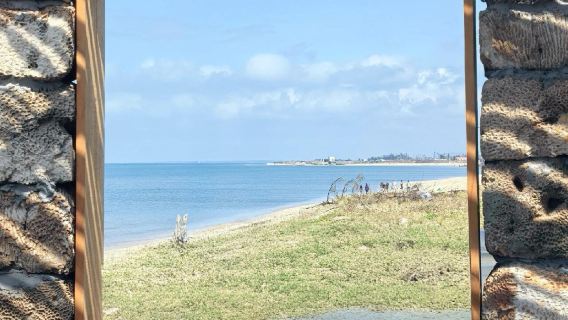
The Antarctic Village in mainland China is located in the southwest of Xuwen County, Guangdong Province, surrounded by Qiongzhou Strait and Beibu Gulf.Xuwen · 28.7 km from downtown

Sea of Pineapple
Sea of Pineapple is not a real sea, but a pastoral landscape formed by vast, continuous pineapple fields in Xuwen, in the southern part of the Leizhou Peninsula, with the core area located around Qujie Town. Xuwen is known as the "Hometown of pineapples in China," with hundreds of thousands of acres of pineapples covering the red soil slopes. The lush green pineapple fields stretch to the horizon along the undulating terrain, looking like layers of green waves on the sea from a distance, which is how the "Sea of Pineapple" got its name. This pastoral landscape is often compared to the "flower fields of Hokkaido" and the "Provence of Europe." The visual appeal of these fields largely comes from their colors: ochre-red soil, lush green pineapple leaves, and golden fruits during the harvest season are layered on top of each other. Rows of white wind turbines stand in the fields, making every snapshot look like a vibrant pastoral masterpiece. Yutangling, with its higher elevation, is a great place to overlook the panoramic view. Once you reach the top, you can see the entire expanse of the fields. The roadsides from Qujie Town towards Jinhe Town and Xiayang Town are also lined with large pineapple fields, perfect for a leisurely self-drive or bike ride. Pineapples ripen in large numbers from early spring to around April, filling the fields with gold and the air with the scent of fruit. This is the perfect time to enjoy the scenery and catch the peak season for fresh pineapples.Xuwen · 21.5 km from downtown

Xuwen Ancient Port
According to the "Han Book", Xuwen Port is the starting port of the maritime "Silk Road". In recent years, a large number of archaeological works have confirmed that the current Xuwen County of Zhanjiang is the location of Xuwen Port. The ruins of Xuwen Ancient Port are located in Erqiao, Nanwan and Shiwei Villages in Wuli Township, southwest of Xuwen County. Since the 1960s, a large number of Han tombs have been discovered in the villages and fields of Huafengling, Dahuang Township, along the southwest coast of Xuwen, and a large number of pottery, steel and beadwork have been unearthed. In November 1993, experts from the Guangdong Provincial Institute of Cultural Relics and Archaeology discovered large-scale Han Dynasty living sites in Erqiao and Shiwei Village, Wuli Township, Xuwen County through large-scale excavations, thus proving that this is the location of Xuwen County and Xuwen Port site in the Han Dynasty. .Xuwen · 9.8 km from downtown

Denglou Cape
Dengloujiao is the Dengjiaolou at the southern end of China's mainland. It was built in the 16th year of Guangxu (1890) and is located in Xuwen County, Zhanjiang City. Landmark South Point. French, British, Russian and other imperial powers built their houses here. Today, there are still western-style houses around the lamp corner building, attracting many tourists to visit. Dengloujiao is not only famous as a relic, but the scenery from the tower is full of style. The vastness of smoke, the vast sea and the sky, as far as the eye can see, are full of lush tropical plants, coconut trees, casuarina trees, acacia trees, cacti, bushes, seaweed flowers, mangroves, etc. Unique scenery to enjoy. Sunrise and sunset, standing on the lighthouse, the day passed quietly. When you are lucky, you can also see the peculiar "waves", one after another, rolling in from far away in Hainan, which is truly spectacular. At the same time, large and complete coral reefs are preserved in the sea area of Dengloujiao, which are rich in variety and colorful. Because the coral reefs have the effect of purifying the sea water, the clean sea exudes infinite charm.Xuwen · 28.8 km from downtown

Shanhudui
Xuwen Coral Reef Nature Reserve is located along the coast of Jiaowei Township and Xilian Town in the west of Xuwen County, Zhanjiang City, Guangdong Province, with an area of about 109 square kilometers. In 1999, the Xuwen County People's Government established a nature reserve to strengthen the protection of natural resources of coral reefs in the area; in 2002, it was upgraded to a municipal nature reserve with the approval of the Zhanjiang Municipal People's Government. After scientific research, the coral species in Xuwen Coral Reef Nature Reserve have been identified and identified as 49 species of 2 orders, 17 families, and 2 species yet to be identified. Among them, there are many rare species, and some species are even discovered for the first time in China.Xuwen · 27.8 km from downtown

The Dahan Sandun Tourist Resort
Dahan Sandun Tourist Area is located in Nanshan Town, Xuwen County, Guangdong Province, which is the site of the departure port of the Maritime Silk Road in the Han Dynasty, and is close to the Beigang Wharf of the Guangdong-Haizhou Railway. The Dahan Sandun Tourist Area is a tourist area with the theme of "Han Dynasty Maritime Silk Road Culture", combined with natural scenery such as mangroves, Dun Island, lakes and fishing villages. Dahan Sandun, Xuwen County, Zhanjiang City, Guangdong Province Xuwen County is located in the southern tip of China, more than 1,000 years earlier than Quanzhou, Fujian. The Dahan Sandun Tourist Area takes the "Han Dynasty Maritime Silk Road Culture" as its theme, and combines the natural scenery such as mangroves, Dun Island, lakes, fishing villages, etc., to create a tourist area with the cultural characteristics of Dahan Marine Port. Legend has it that there are three small piers in the bay of Sandun New Countryside Area in Dahan, called Sandun Island. Sandun Island was called "Yingdao" in ancient times, also called "Little Penglai".Xuwen · 10.7 km from downtown

Haikou arcaded streets
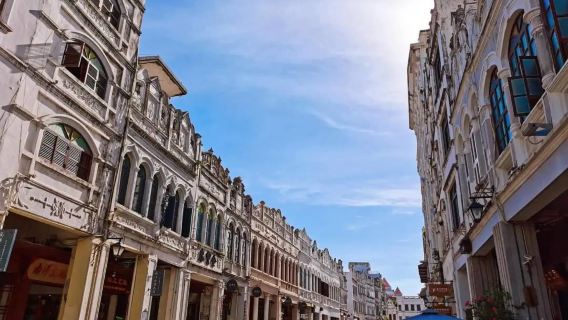
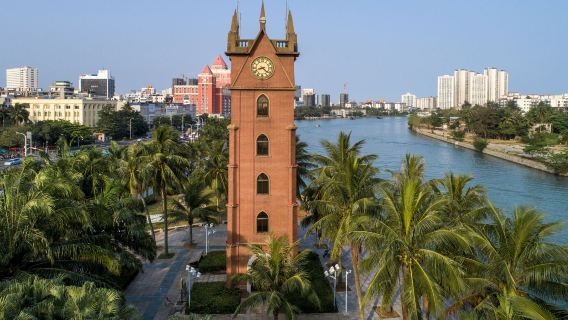
Qilou Old Street is a distinctive streetscape in Haikou City. It is mainly distributed on Deshengsha Road, Xinhua South Road, Zhongshan Road, Boai Road and Jiefang Road. Qilou was built by the overseas Chinese returning from Nanyang and draws on the local architectural styles. Now, various businesses operate out of these Nanyang buildings. It is important to note that buying things here requires fierce bargaining, do not be embarrassed!Haikou · 36.3 km from Xuwen

Hainan Museum
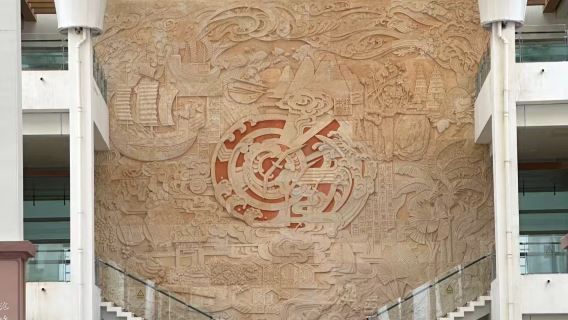
The Hainan Museum is a comprehensive museum in Hainan province, located at 76 Guoxing Avenue, Qiongshan district, Haikou. Opened on November 15, 2008, it is a national first-class museum and a national 4A-level tourist attraction. It has been awarded honors including "national advanced collective in culture and tourism systems" and "national advanced collective in cultural relics systems," and has been selected as a national research and practice education base for primary and secondary school students, as well as one of China's first batch of "great ideological and political courses" practical teaching bases. The exhibitions at Hai Nan museum are structured around the Ming dynasty scholar Qiong Jun's "Ode to the marvelous southern land", showcasing Hainan's local cultural charm through multiple dimensions including geography, resources, history, customs, intangible heritage, and maritime civilization. The museum currently features three permanent exhibitions: "Sailing the southern seas - exhibition of South China Sea maritime civilization", "Beyond borders - exhibition of Hainan history", and "Between mortal and divine - exhibition of Hainan customs", along with two special exhibitions: "Queen of woods - exhibition of Hainan huanghuali" and "King of fragrances - exhibition of Hainan agarwood". These are complemented by a "four-in-one" intangible heritage display system creating a special exhibition on Hainan's intangible cultural heritage. Notably, "The direction of the sea - special exhibition of the Huaguangjiao No. 1 shipwreck" and "Sailing the southern seas - exhibition of South China Sea maritime civilization" won the 10th (2011) and 15th (2017) national top ten museum exhibition awards respectively. In recent years, the "Eternal charm, ageless Su Dongpo - Su Shi-themed cultural relics exhibition" launched by Hai Nan Museum won the 22nd (2024) national top ten museum exhibition awards. The "Like heavenly craftsmanship - technological mysteries in ancient Chinese cultural relics" was selected for the "Reading China in museums - promoting excellent traditional Chinese culture and cultivating socialist core values" themed exhibition project jointly organized by the National Cultural Heritage Administration and the Cyberspace Administration of China. The Hai Nan museum serves as an important window for visitors from home and abroad to comprehensively understand Hainan's natural landscape, ethnic history, and cultural arts, attracting travelers from all directions. The museum will continue actively planning and introducing high-quality exhibitions, deepening domestic and international collaborations, and striving to build Hainan Free Trade Port into a cultural hub for "viewing China and seeing the world".Haikou · 40.4 km from Xuwen

Holiday Beach
Holiday beach is located on the western side of Haikou city. To the left of the beach are luxuriant trees, and to the right lies the Qiongzhou Strait. The sunshine, sea, sandy beaches, and coconut palms here set each other off nicely to form a beautiful natural scene. At the weekends, you can come here with friends to enjoy barbecue and beer on the beach. When you've finished eating, enjoy the unique pleasure of a stroll by the sea.Haikou · 33.3 km from Xuwen

Cloudscape Library
Cloudscape Library is located in the coastal area of Century Park along Haikou Bay, right by the coastline. The entire building is cast from white fair-faced concrete, with curved surfaces seamlessly connecting the floor, walls, and ceiling, leaving almost no visible beams or columns. The exterior stretches out like clouds, while the interior resembles a cave carved out by the sea, with openings of various sizes bringing natural light and sea views directly into the library. The library is compact, featuring a reading space that can house approx. 10,000 books, and is equipped with a multi-functional audio-visual area, a café, a terrace, a rooftop garden, a baby care room, and a public lounge area. It is not just a library, but also a public living room facing the sea. Pick a book, sit by the window, and you can see the sea as soon as you look up. At dusk, the sun slowly sets over the sea horizon not far in front of the library, which is the signature view here.Haikou · 34.3 km from Xuwen
Experiences you can't miss in Xuwen
Featured Cultural experiences in Xuwen
View all Cultural experiences
FromUS$373.69

![[Free Trade Port Business Concierge] Haikou professional translation + dedicated car service + flexible itinerary! For meetings, inspections, and investment matchmaking, we specialize in the Free Trade Port to help you connect with Hainan's opportunities.](https://ak-d.tripcdn.com/images//0580m12000qaisimiD04A_C_568_320.jpg?_fr=wc)
Featured Day tours in Xuwen
View all Day tours
Free cancellation
Instant confirmation
Book now for tomorrow
FromUS$10.17


5.0/5
· 7 reviewsFree cancellation
Instant confirmation
Book now for tomorrow
FromUS$186.85
![[Guided Walking Tour] Explore the Culture of Haikou Arcaded Streets + Discover Local Street Food Delicacies](https://ak-d.tripcdn.com/images/0350q12000r9rtcl30C58_C_568_320.jpg?_fr=wc)
FromUS$220.82

Free cancellation
Book now for tomorrow
FromUS$220.82

FromUS$441.63
Free things to do in Xuwen
South Pole Village
Xuwen · 28.7 km from downtownSea of Pineapple
Xuwen · 21.5 km from downtownXuwen Ancient Port
Xuwen · 9.8 km from downtownDenglou Cape
Xuwen · 28.8 km from downtownShanhudui
Xuwen · 27.8 km from downtownThe Dahan Sandun Tourist Resort
Xuwen · 10.7 km from downtownHaikou arcaded streets
Haikou · 36.3 km from XuwenHainan Museum
Haikou · 40.4 km from XuwenHoliday Beach
Haikou · 33.3 km from XuwenCloudscape Library
Haikou · 34.3 km from Xuwen
What travelers say about Xuwen

uztzuz13 May 2026
5.0
The Antarctic Village of mainland China, located in Jiaowei Township, Xuwen County, Zhanjiang City, Guangdong Province, covers an area of approximately 37 square kilometers and has a population of about 32,000. Surrounded by the Qiongzhou Strait and the Beibu Gulf, its terrain extends in a bull's horn shape to the confluence of the two straits. As the southernmost point of mainland China, this attraction draws visitors from all over the world.
South Pole Village

George King6 October 2021
5.0
Baltic Sea is a homophonic pun. It is the largest pineapple agricultural base in China. Following the navigation, we came here. There is a small viewing platform on the roadside. It is very good to take pictures with the light before dusk. March to May is the peak season for pineapple harvest.
Sea of Pineapple

小龙女SMXY12 September 2022
5.0
Xuwen Port, namely the site of the ancient Xuwen Port, is located in Erqiao, Nanwan and Shiwei Village in Wuli Township, southwest of Xuwen County. Since the 1960s, a large number of Han tombs have been discovered in villages and fields along the southwest coast of Xuwen, mainly in Huafengling, Dahuang Township, and a large number of pottery, steelware and beads have been unearthed. According to the "Book of Han", Xuwen Port is the starting port of the "Silk Road" on the sea. In recent years, a large number of archaeological works have confirmed that Xuwen County, Zhanjiang is the location of Xuwen Port.
Chinese name
Xuwen Port
Geographic location
Wuli Township, southwest of Xuwen County
Surrounding attractions
Yingdao Lianbi, Shiwei Mangrove, etc.
Relics discovery time
November 1993
Geographic location Archaeological discovery Natural landscape map information TA said
Geographic location
In November 1993, experts from the Guangdong Provincial Institute of Cultural Relics and Archaeology discovered a large range of Han Dynasty living sites in Erqiao and Shiwei Village, Wuli Township, Xuwen County through large-scale exploration, thus proving that this is the location of Xuwen County in the Han Dynasty and the site of Xuwen Port.
Archaeological discoveries
① The Han Dynasty ancient port living site area is located in the middle and eastern part of Erqiao and Nanwan Village to the north of Shiwei Village, with a strip distribution and an area of about 50,000 square meters.
The ruins of the Han Xuwen Castle Wall: Located on the cliff of the high platform in the west of Erqiao Village, Wuli Township, facing Gangtou Bay, with a drop of about ten meters, a total length of more than 500 meters, and a surface area of more than 200,000 square meters. Various Han pottery and tile fragments are scattered on the surface, and obvious rammed earth layers of mud, sand and stone are found on the cliff.
Bagua navigation lamp holder: Located on the high cliff of Shiwei Ridge in the north of Shiwei Village, Wuli Township, less than 10 meters from the bay. The seat is carved from a natural boulder, octagonal, 2 meters in diameter and 40 centimeters deep. The octagonal corners are decorated with Bagua patterns. It is a typical navigation lamp holder of the Han and Tang Dynasties.
② The Han Dynasty burial area is located in the back Donggang Ridge of Erqiao Nanwan Village to Nagan Village, mainly single-chamber vaulted tombs and earth pit tombs.
Natural landscape
① Yingdao Lianbi: Sandun, formed by three islands in a row on the sea, was called "Xiaolianshan" in ancient times and is one of the eight scenic spots in Zhanjiang. The three small islands form a natural barrier for the ancient port. There are freshwater wells on the islands. The "Xuwen County Chronicles" in the third year of Xuantong in the Qing Dynasty recorded: "There are three piers in front of the sea, and there is a freshwater well called Longquan in the middle. When praying for rain during drought, take a spoonful of water from this well, and sweet rain will come immediately."
② Shiwei Mangrove: Along the Nanshan to Shiwei Weir, the area is more than 1,000 acres, shaded by green trees, and flocks of seabirds. It is famous for producing "Ganxie Eel", "Ganxie Crab", "Sweet Snail" and "Red Minnow".
③ Nanshan Coconut Grove: In Nanshanxia Village, the area is about 20,000 square meters, with coconut breeze and sea rhyme, chicken sounds and thatched houses, and a unique coastal fishing village style.
Transportation: Take a bus from Zhanjiang Bus Terminal to Xuwen County, and then transfer or charter a car to go there.
Map Information
Address: 400 meters northeast of Dahan Sandun Tourist Area, Nanshan Town, Xuwen County, Zhanjiang City, Guangdong Province
Xuwen Ancient Port

仙湖晚霞12 December 2024
4.0
Dengloujiao is indeed famous, and the natural scenery is also beautiful! It's just that it's under renovation everywhere, and it feels like there are few parking spaces in the scenic area! The roads are crowded! It should be more beautiful if it is well built and managed!
Denglou Cape

是张小小吖6 December 2024
5.0
Xuwen Coral Reef Nature Reserve is really amazing! The coral reefs there are colorful and varied in shape, it is simply a fantasy world under the sea, which makes people marvel at the wonders of nature!
Shanhudui

洞庭春秋19 June 2020
4.0
The beauty of Xuwen lies in its greenness. Elegant environment is the criterion for judging the quality of greening construction projects. The blue sea water of Xuwen is the best explanation of environmental governance. A green home is the hard truth.
The Dahan Sandun Tourist Resort

爱旅行的Monica15 February 2026
5.0
A city's history and culture are its most captivating aspects. Haikou's arcade buildings bear witness to the "Down to Southeast Asia" migrations that occurred four times during this period.
Many Hainan families have relatives in Southeast Asia, and many people arrived in these regions during these migrations. My family, too, was caught up in this historical tide, arriving in Thailand to begin their lives of struggle.
I was born and raised in these arcade buildings. They are not just newly built ancient architectural complexes; they are a living, breathing reflection of life, a testament to the ever-evolving lives of the people of Haikou. This is far more powerful than any artificial landscape!
Haikou arcaded streets

Anonymous user25 August 2026
5.0
This guided tour was a fantastic experience! Ms. Shan has a solid foundation of knowledge, and her explanations were vivid and easy to understand. She captivated the children by explaining the historical background and stories behind the artifacts, keeping them engaged and helping them understand and remember many key points. The pacing was excellent throughout, and she provided detailed explanations of the important exhibits. It's perfect for a family trip and highly recommended!
Hainan Museum

一直在路上的猫22 March 2026
4.0
Holiday Beach, Haikou's most beautiful beach.
Having traveled from Sanya through Wanning, then Wenchang, and finally Haikou, I've seen many beautiful beaches, but Holiday Beach still surprised me with its stunning beauty.
Located on the northwest coast of Haikou, it's a national 4A-level open coastal scenic area, opened in 1995. Admission is free (except for attractions). It stretches 7 kilometers (4.5 kilometers in the core section) and borders the Qiongzhou Strait to the north.
It's divided into four areas: beach sunbathing, water sports, marine dining, and leisure resort. Activities include sea bathing, beach volleyball, surfing, hot springs, and sunset viewing and beach barbecues are popular.
It's about 10 kilometers from the city center, accessible by taxi or bus. Parking is convenient, the sand is quite clean, and there are places to rinse your feet. The view of the blue sky, white clouds, and sea at dusk is truly beautiful.
Holiday Beach

燕~simona8 December 2025
5.0
We visited the Cloud Cave Library in the evening, which was a bit rushed, but we managed to get inside. There were many tourists there, all there to take photos. The library is built by the sea and has a very unique design. Each entrance offers a different and beautiful view, which is truly captivating. The interior of the library is also very distinctive, with different views from different vantage points. In short, visiting here was a wise and correct choice.
Cloudscape Library


