How to Book Sleeper Train in China: Complete Guide for Travelers

Are you planning a trip to mainland China soon? If you want to visit multiple cities in one trip, a China sleeper train or high-speed train can be an essential mode of transport. An overnight journey can also save you daytime travel hours and the cost of one hotel night.
In this article, Trip.com explains how to book sleeper train in China and the different train and sleeper types. UAE travelers can also learn how to use a passport to book China train tickets online and board the train.
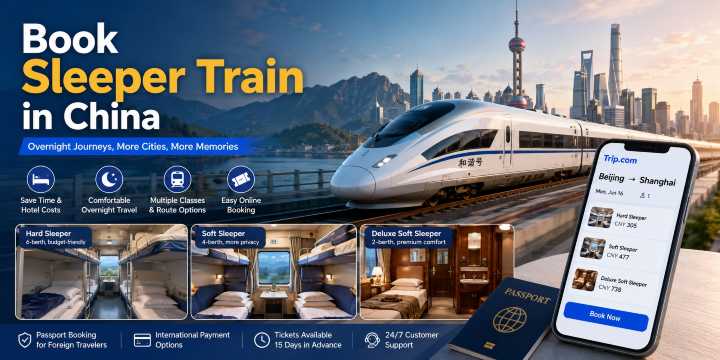
Mainland China High-Speed Rail Booking
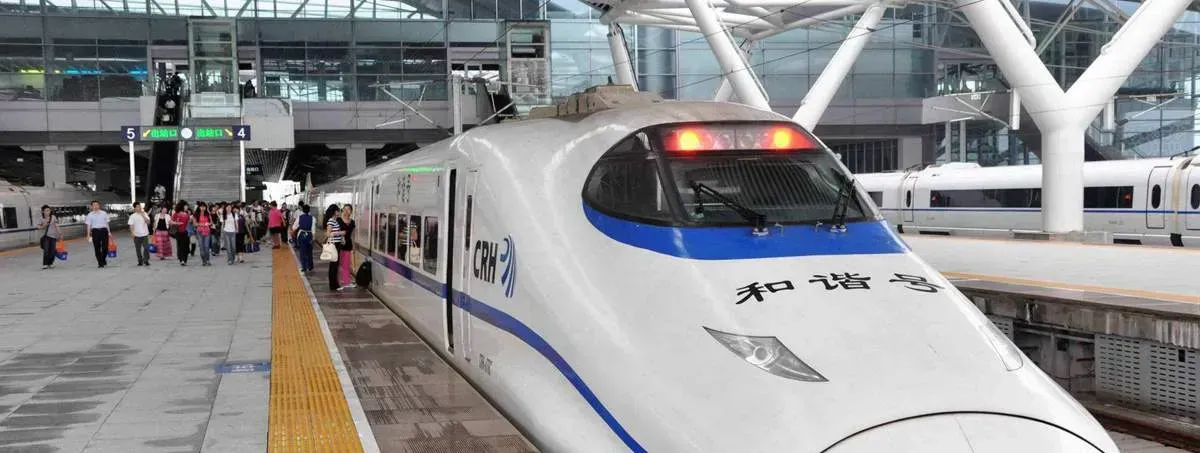
The easiest way to complete a China sleeper train booking from the UAE is through Trip.com’s China train booking service. You can search in English, compare available classes, enter your passport details, and pay using international Visa, Mastercard, Apple Pay, Google Pay, or other supported payment methods.
You can also book through the official China Railway 12306 website, its app, or at a railway station in China. Tickets usually become available 15 days before the departure date, including the travel date. Popular sleepers can sell out quickly during Chinese New Year, the National Day holiday, and summer.
To complete a China high-speed train booking online, enter your name and passport number exactly as they appear on your passport. You must carry the same original passport when traveling.
Shanghai - Hangzhou
- DepartureShanghai Hongqiao
- ArrivalHangzhou East
- Duration~45m
- Price (2nd Class)From $8.00
Shanghai - Beijing
- DepartureShanghai Hongqiao
- ArrivalBeijing South
- Duration~6h
- Price (2nd Class)From $79.40
Shanghai - Shenzhen
- DepartureShanghai Hongqiao
- ArrivalShenzhen North
- Duration~7h
- Price (2nd Class)From $81.46
Guangzhou - Shenzhen
- DepartureGuangzhou East
- ArrivalShenzhen
- Duration~1h
- Price (2nd Class)From $10.00
Shenzhen - Guangzhou
- DepartureShenzhen North
- ArrivalGuangzhou South
- Duration~1h
- Price (2nd Class)From $10.34
Guangzhou - Hongkong
- DepartureGuangzhou South
- ArrivalHongkong West Kowloon
- Duration~1h
- Price (2nd Class)From 29.85
About High-Speed Rail in Mainland China
Since the launch of the Beijing–Tianjin Intercity Railway in 2008, mainland China has developed the world's largest high-speed rail network.
High-Speed Rail Types in Mainland China
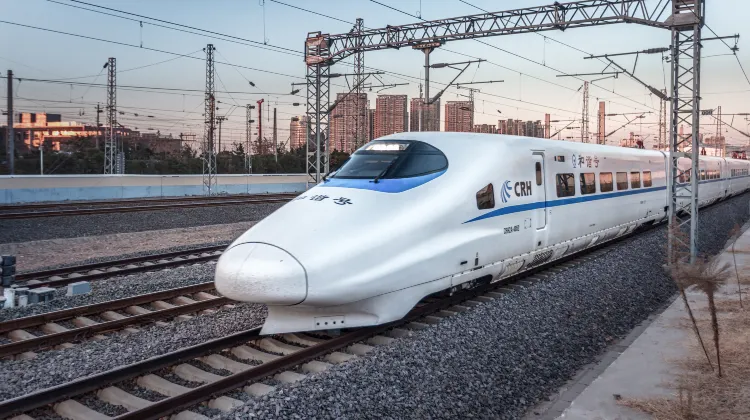
Mainland China’s high-speed and conventional trains are distinguished by letters such as G, D, C, Z, T, K, and Y. G, D, and C are generally classified as high-speed or intercity trains, while Z, T, and K are conventional trains. Here’s what each letter means:
G: Pronounced “Gao,” this stands for high-speed train. It is one of the fastest and most premium train categories in mainland China, with some services operating at up to 350 km/h. These trains usually connect major cities and offer Business, First, and Second Class. Fuxing trains are among the main trainsets used on these routes.
D: Pronounced “Dong,” this refers to electric multiple-vehicle trains. D trains generally operate at speeds of up to 250 km/h. Some run during the day with seats, while selected long-distance services operate as an EMU sleeper train in China.
C: These are intercity high-speed trains. Speeds and operating hours vary by route. They usually connect nearby cities or major urban areas over shorter distances.
Z: Direct Express trains can reach speeds of around 160 km/h. They operate mainly on long-distance routes and make fewer stops than many other conventional trains. Some offer hard, soft, or deluxe soft sleepers.
T: Express trains can reach speeds of around 140 km/h. They operate between provinces and regions, making more stops than Z trains. They are often more affordable than high-speed services.
K: Fast trains generally reach speeds of up to 120 km/h. These trains make more stops and commonly offer sleeper berths, making them suitable for budget-conscious travelers.
Y: These are tourist trains created for specific routes or travel experiences. Their carriages, facilities, and schedules vary. Some offer sleeper cabins, dining areas, lounges, or themed activities.
How Fast Is High-Speed Rail in Mainland China?
High-speed trains in mainland China usually operate at speeds of between 200 and 350 km/h, depending on the train and route. The fastest scheduled G trains travel at up to 350 km/h.
For example, some high-speed services between Hong Kong West Kowloon and Guangzhou South take around 45 to 60 minutes. The fastest daytime trains between Shanghai Hongqiao and Beijing South take approximately 4.5 hours, although the exact journey time depends on the service.
Top Routes
| Departs | Arrives | Duration | Price | Book Online |
|---|---|---|---|---|
| Beijing | Xi'an | 8h 28m | From ¥300 | Book Ticket |
| Hong Kong | Beijing | 10h 28m | From ¥1440 | Book Ticket |
| Beijing | Shanghai | 12h 18m | From ¥516 | Book Ticket |
| Guangzhou | Shanghai | 11h 12m | From ¥860 | Book Ticket |
| Hong Kong | Shanghai | 10h 55m | From ¥1170 | Book Ticket |
| Beijing | Guangzhou | 10h 20m | From ¥910 | Book Ticket |
| Shanghai | Beijing | 12h 11m | From ¥508 | Book Ticket |
| Beijing | Chongqing | 17h 34m | From ¥481 | Book Ticket |
| Beijing | Chengdu | 12h 01m | From ¥840 | Book Ticket |
Scroll to see more routes...
Top Routes
| Departs | Arrives | Duration | Price | Book Online |
|---|---|---|---|---|
| Beijing | Xi'an | 11h 48m | From ¥254.5 | Book Ticket |
| Beijing | Lhasa | 40h 20m | From ¥720 | Book Ticket |
| Beijing | Shanghai | 13h 23m | From ¥304.5 | Book Ticket |
| Guangzhou | Shanghai | 16h 32m | From ¥353 | Book Ticket |
| Chengdu | Lhasa | 34h 31m | From ¥627.5 | Book Ticket |
| Beijing | Guangzhou | 21h 40m | From ¥426 | Book Ticket |
| Shanghai | Beijing | 14h 36m | From ¥304.5 | Book Ticket |
| Beijing | Chongqing | 24h 33m | From ¥389 | Book Ticket |
| Beijing | Chengdu | 27h 19m | From ¥437 | Book Ticket |
Scroll to see more routes...
How Do You Take a High-Speed Train in Mainland China?
UAE travelers can purchase train tickets through Trip.com, the official China Railway 12306 website or app, or a railway station ticket counter. WeChat and Alipay may also offer railway booking services, but they can be less convenient for travelers without a mainland Chinese account or payment method.
Most mainland China train journeys use electronic tickets linked to the passenger’s identity document. Foreign passengers should carry the original passport used to make the booking. You do not normally need to collect a paper ticket.
When preparing to board, follow these steps:
- Arrive at the station around 45 to 60 minutes before departure.
- Present your passport at the entrance.
- Use a staffed gate if the automatic passport reader does not recognize your document.
- Pass through the security checkpoint and place your bags on the scanner.
- Check the departure board for your waiting area and gate number.
- Present your passport again when the gate opens.
Access to the platform usually opens around 15 to 30 minutes before departure. Gates may close several minutes before the train leaves, so do not arrive at the last minute.
What Are the Features and Fenefits of Fleeper Trains on Mainland China?
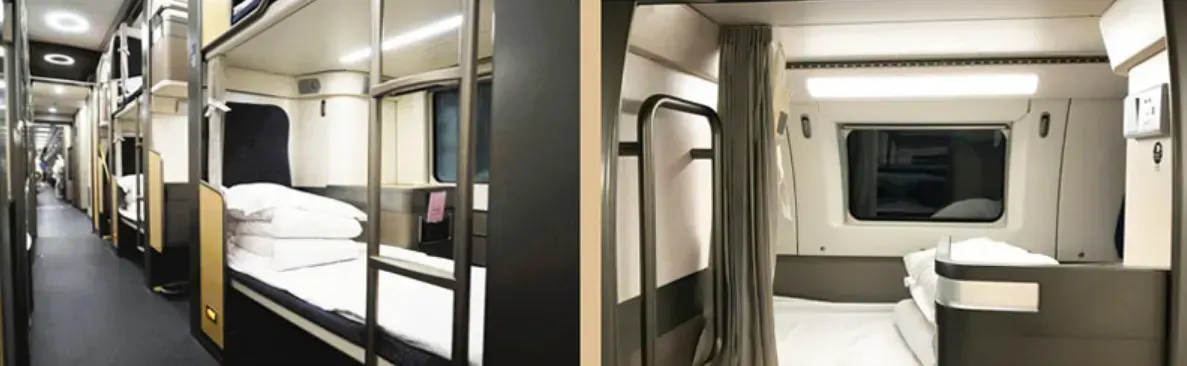
The China overnight train lets you travel between cities while you sleep. Sleeper berths are widely available on conventional Z, T, and K trains, while selected D and G services also offer high-speed sleepers.
The layout depends on the train. Conventional sleeper carriages commonly offer six-berth hard sleeper sections, 4-berth soft sleeper compartments, or 2-berth deluxe soft sleeper compartments. High-speed sleeper layouts vary, so not every carriage has 10 compartments or 4 berths in each cabin.
Compared with regular seating, sleeper berths offer more space to rest. Facilities may include charging sockets, reading lights, hot-water dispensers, storage areas, washbasins, and shared toilets. LCD screens, private toilets, and kettles are available only on certain trains and should not be expected on every service.
Beijing Hotels
Shanghai Hotels
Guangzhou Hotels
Shenzhen Hotels
See All Hotels
 NO.1
NO.1








Hard Sleeper vs. Soft Sleeper in China
The main difference between a hard and soft sleeper in China is the cabin layout and level of privacy. Hard sleeper sections are open to the corridor, while soft sleeper compartments usually have a door.
Hard Sleeper Train, China
A hard-sleeper train, China normally has 6 berths arranged in 2 columns, with lower, middle, and upper beds. Despite the name, each berth has a mattress, pillow, and bedding.
The sleeping sections are open to the corridor and do not have private doors. Lower berths are easier to access, while upper berths usually offer more privacy.
Soft Sleeper Train, China
A soft sleeper train, China usually has 4 berths in an enclosed compartment. The cabin commonly has 2 lower and 2 upper berths, a door, a small table, reading lights, and storage space.
Soft sleepers cost more than hard sleepers but provide greater privacy. They are a practical choice for travelers taking their first China night train.
Deluxe Soft Sleeper, China
A deluxe soft sleeper, China usually has 2 berths in an enclosed cabin. Depending on the train, the compartment may include a sofa, washbasin, wardrobe, or private toilet.
This category may also appear as a superior soft sleeper or premium sleeper. Availability is limited, and the exact facilities depend on the train.
China eSIM Recommendations
See all attractions



Can You Book a Private Room on a China Sleeper Train?
You can book a China sleeper train private room when a service offers a 2-berth deluxe or superior sleeper compartment. Each passenger still needs an individual ticket linked to a valid identity document.
A normal soft sleeper cabin contains 4 berths. Booking 1 or 2 berths does not guarantee private use of the entire cabin, as the remaining berths may be sold to other passengers.
Book Sleeper Train in China: Price and Class Comparison
Sleeper train fares usually range from around CNY 200 to CNY 900 (AED 105 to AED 475). For example, Beijing to Shanghai costs about CNY 305–326 (AED 160–172) for a hard sleeper and CNY 477–498 (AED 251–262) for a soft sleeper.
The cost may also vary by berth. Lower berths can cost slightly more than middle or upper berths on some conventional trains.
Hong Kong Sleeper High-Speed Trains to Beijing & Shanghai
Hong Kong launched overnight high-speed sleeper services to Beijing and Shanghai on 15 June 2024. These trains connect Hong Kong West Kowloon with Beijing West and Shanghai Hongqiao.
The available travel classes depend on the route and service. Standard sleeper compartments usually have 4 berths, while superior sleeper cabins provide 2 berths and more privacy. Second Class seating may also be available.
The Superior Sleeper has a private 2-person cabin with features such as a sofa and storage space. The standard Sleeper has 4 berths in an enclosed cabin. Facilities can vary, so check the current MTR sleeper train information before booking.
If you want to travel from Hong Kong to Shanghai or Beijing without taking a flight, this service is worth considering.
Flights to Shanghai
Flights to Chongqing
Flights to Xiamen
Flights to Chengdu
See all flights


Popular China Sleeper Train Routes
Popular China sleeper train routes connect major cities that would otherwise require a long daytime journey.
Beijing to Shanghai Sleeper Train
The Beijing to Shanghai sleeper train is available on selected conventional and overnight high-speed services. Conventional sleepers can take around 12 to 15 hours, while selected high-speed sleeper services may complete the journey more quickly.
Check the stations carefully when booking. Daytime high-speed trains commonly use Beijing South and Shanghai Hongqiao, while some conventional overnight trains use Beijing Railway Station and Shanghai Railway Station.
Beijing to Xi’an Sleeper Train
Many conventional overnight services from Beijing to Xi’an depart from Beijing West Railway Station. Some arrive at Xi’an Railway Station, while daytime high-speed trains usually arrive at Xi’an North Railway Station.
These are different stations, so check the name shown on your ticket before arranging your hotel or transfer.
You can use Trip.com’s AI Trip Planner to organize your rail route, hotels, and sightseeing schedule.
Shanghai - Hangzhou
- DepartureShanghai Hongqiao
- ArrivalHangzhou East
- Duration~45m
- Price (2nd Class)From $8.00
Shanghai - Beijing
- DepartureShanghai Hongqiao
- ArrivalBeijing South
- Duration~6h
- Price (2nd Class)From $79.40
Shanghai - Shenzhen
- DepartureShanghai Hongqiao
- ArrivalShenzhen North
- Duration~7h
- Price (2nd Class)From $81.46
Guangzhou - Shenzhen
- DepartureGuangzhou East
- ArrivalShenzhen
- Duration~1h
- Price (2nd Class)From $10.00
Shenzhen - Guangzhou
- DepartureShenzhen North
- ArrivalGuangzhou South
- Duration~1h
- Price (2nd Class)From $10.34
Guangzhou - Hongkong
- DepartureGuangzhou South
- ArrivalHongkong West Kowloon
- Duration~1h
- Price (2nd Class)From 29.85
Planning Your China Train Journey from the UAE
Before booking your train journey, compare flights from the UAE to China and choose an arrival city that works with your rail itinerary. Beijing, Shanghai, Guangzhou, Xi’an, and Chengdu are useful starting points for multi-city trips.
You can also book hotels in China close to the correct railway station. This is especially useful if your train leaves early or arrives late.
A China eSIM can help you access your booking details, maps, and translation apps. Travel insurance and airport transfers can also be useful if your itinerary includes separate flights and train bookings.
We hope that after reading this introduction to high-speed and sleeper trains in mainland China, you have a clearer understanding of the options. If you want to purchase high-speed rail or sleeper tickets, you can compare routes and book China train tickets online through Trip.com.
China Train and High-Speed Rail FAQs
-
Do China high-speed trains have standing tickets?
-
Can UAE travelers buy China train tickets?
-
How can I buy China high-speed train tickets without Chinese mobile payment methods?
-
How far in advance can I book sleeper train in China?
-
Do all high-speed trains in China have sleepers?
-
Is a soft sleeper worth the extra price?
-
Can I choose a lower sleeper berth?
-
Do I need a paper train ticket in China?
Disclaimer: This article has been provided by an individual contributor or third party platform. If there is any discrepancy regarding the copyright, please contact us directly and we will delete the content immediately.
Trendings
-
More about China Trains
- China High Speed Train Seat Map
- China Train Luggage
- How to Take a Train in China
- 1st class vs 2nd class on China high speed trains
- China Train App
- Shenzhen to Hong Kong
- China Train Types
- China Sleeper Train
- China Train Tickets Change Refund Cancellation
- China Train Classes
- Cheap Train Tickets China
- KTX Booking
- High Tea NYC
- Trains to Amsterdam Centraal
- Trains to Polegate
- Paris to Cologne trains
- Trains to Barmouth
- York to Inverness trains
- homepage
- Florence to Venice trains