Things to do in Dengzhou
Explore top experiences
Top 10 attractions in Dengzhou


Ancient Longzhong
Ancient Longzhong is located among the mountains west of Xiangyang city, where Zhuge Liang lived in seclusion during his youth. Legend has it that this place is surrounded by mountains, with only one peak "rising abruptly in the center," standing prominently among the ridges, hence the name "Longzhong." At the age of seventeen, Zhuge Liang came here with his uncle, farming and studying diligently for nearly a decade, earning the nickname "Crouching dragon." Later, Liu Bei visited his thatched cottage three times, and Zhuge Liang proposed the "Longzhong Plan" outlining the tripartite division of the world. Ancient Longzhong thus became known as the "cradle of wisdom" and the "birthplace of the tripartite division strategy." Today, the attraction still preserves traces of this history: the Wuhou Temple, originally built during the Jin dynasty, rises in tiers along the mountain slope as a site for commemorating Zhuge Liang; the Three visits hall was constructed to honor Liu Bei's three visits, with ancient cypresses in front said to be the very trees where Liu, Guan, and Zhang tied their horses; thatched cottage pavilion, farming fields, small rainbow bridge, hexagonal well, old dragon cave, and knee-embracing rock collectively form the "Ten scenes of Longzhong" passed down since the Ming dynasty—the knee-embracing rock is believed to be where Zhuge sat chanting "Liangfu yin." At the entrance stands a Qing-dynasty bluestone archway inscribed with "Ancient Longzhong," flanked by phrases from "Admonitions to my son"—"Indifference to fame reveals one's ambition" and "Tranquility leads to far-reaching vision"—with Du Fu's famous couplet "Three visits exhausted the world's schemes, two reigns revealed the veteran's heart" carved on pillars, serving as the attraction's iconic photo spot. Hiking up to Tenglong Pavilion atop the mountain offers panoramic views of Longzhong's forests and fields; nestled in the valley lies a thatched-roof theater once staging the large-scale outdoor drama "Thatched cottage: Zhuge Liang," chronicling his life. "Romance of the Three Kingdoms" describes this place as having "hills not lofty but elegant, waters not deep but clear." The leisurely pace of the visit allows you to share the story of the Three Visits to the Thatched Cottage with your children as you stroll. If you're interested in Zhuge Liang's life, we recommend setting aside half a day to explore the inscriptions and exhibits in detail, which is more rewarding than a hurried visit.Xiangyang · 77.8 km from Dengzhou

Yangtze River Three Gorges
The Yangtze River Three Gorges is a grand canyon formed by the Yangtze cutting through the Wushan Mountains. It stretches nearly 200 km from White Emperor City in Fengjie, Chongqing, in the west to Nanjin Pass in Yichang, Hubei, in the east, connecting three gorges—Qutang, Wuxia, and Xiling—from west to east. This stretch of river has served as a vital waterway between Ba and Chu since ancient times. Li Bai's verse "Departing at dawn from White Emperor City veiled in colorful clouds" depicts the eastbound journey from the gorge entrance, while Du Fu left his famous line "The endless Yangtze rolls on and on" in Fengjie. Each gorge has distinct characteristics, often summarized as "majestic Qutang, graceful Wuxia, and perilous Xiling." Qutang Gorge spans only about 8 km but is renowned for its sheer cliffs. At Kuimen, its entrance, the river abruptly narrows to less than 100 m between knife-cut bluffs—a scene featured on the back of China's fifth series CNY 10 banknote. Ancient plank road holes and Wind Box Gorge's hanging coffins remain visible on the cliffs. Wuxia Gorge extends over 40 km like a winding gallery, with the Twelve Peaks lining its banks. Goddess Peak stands elegantly photogenic in morning mist. Xiling Gorge was once notorious for rapids, but the Three Gorges Dam has transformed its upper reaches into a "high gorge with placid waters." Riverside landmarks like White Emperor City and Huangling Temple are worth visiting. Cruising is the best way to experience the gorges. Long-distance ships sail downstream, while short round-trip boats shuttle through key sections. Watching peaks drift by from the deck offers a more immersive perspective than shore viewing. Morning mist often creates ideal conditions for photographing Kuimen and Goddess Peak. Cliffside plank road relics and inscriptions may flash by during the cruise—keep an eye out to avoid missing them.China · Yichang

Guanque Tower
A national AAAA-level tourist attraction and one of the top ten attractions in Shanxi Province, Guanque Tower is located on the eastern bank of the Yellow River west of Puzhou Ancient City in Yongji, Shanxi. Alongside the Yellow Crane Tower in Wuhan, Hubei; Yueyang Tower in Yueyang, Hunan; and Tengwang Pavilion in Nanchang, Jiangxi, it is renowned as one of China's four great historical and cultural towers. Originally built during the Northern Zhou Dynasty (557–571 AD) by military commander Yuwen Hu as a defensive watchtower, the tower earned its name from the storks that frequently perched on its structure. The Tang Dynasty poet Wang Zhihuan's celebrated poem "On the Stork Tower" ("The sun along the mountain bows; The Yellow River seawards flows. You will enjoy a grander sight; If you climb to a greater height.") has become an enduring masterpiece, widely known both domestically and internationally. After standing for over 700 years through the Tang and Song dynasties, the tower was destroyed during warfare in the early Yuan Dynasty (1222 AD). The reconstructed Guanque Tower follows Tang-style architecture, featuring four eaves externally with three visible tiers, while internally comprising six floors. With a total height of 73.9m, it epitomizes the grandeur of the Tang era. Ascending Guanque Tower not only offers breathtaking panoramic views but also immerses visitors in the brilliance of China's 5,000-year civilization.China · Yongji

Fusheng Pagoda
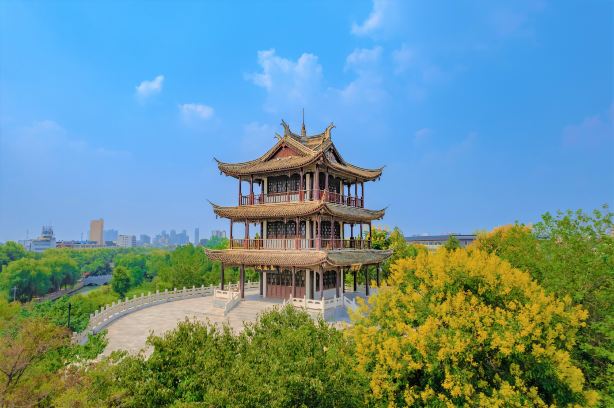
Dengzhou · 890m from downtown

Sui and Tang Luoyang City National Heritage Park
Sui and Tang Luoyang City National Heritage Park, located in the heart of Luoyang, was the core area of the imperial city ruins from the Sui, Tang, Five Dynasties, and Song periods. Divided into four entrances (east, west, south, and north), this heritage park preserves the complete imperial palace from Empress Wu Zetian's reign - the very site where China's only female emperor held her coronation ceremony.MingtangAncient Chinese architectural marvel - the 120m-high Heavenly Palace. Sui and Tang Dynasties Luoyang City National Heritage ParkOriginally built in 605 AD during Emperor Yang of Sui's reign and flourishing in the Tang Dynasty—especially under Empress Wu Zetian's rule—this site boasts over 1,400 years of profound historical and cultural significance. It once served as the central hub of China's Grand Canal during the Sui Dynasty, the eastern starting point of the Silk Road, and featured the well-developed Luonan Li-Fang urban system, a magnificent central city axis, and numerous renowned scholar gardens.China · Luoyang

Yangtze River
The Yangtze River flows through Yichang, located at the junction of the upper and middle reaches, and serves as the starting point of the Yangtze River Three Gorges. The river surface is wide and calm, with layered green mountains on both banks, and the city is built along the river, creating a landscape where the mountains, water, and city complement each other. From the south bank, the urban area on the north bank stretches along the river, with bridges spanning across, offering a wide view. A representative view here is the canyon landscape, with towering cliffs on both banks and the river flowing through the canyon. When passing by boat, you can experience the narrowness and grandeur of the canyon up close. When the tour boat passes through the ship lock, the vessel rises and falls slowly with the water level in the lock chamber, which is a unique experience. There are also places along the river suitable for walking and viewing. The riverside promenade extends along the north bank, shaded by trees, making it a great spot for viewing the river up close, taking photos, and strolling. The high ground on the south bank offers a panoramic view of the city's river scenery, and at sunset, the river reflects the setting sun, creating a delightful view.China · Yichang

Three Gorges Grand Waterfall
The Three Gorges Grand Waterfall, originally named the White Fruit Tree Waterfall, is located in the gorge of the Xiaofeng Tourist Area in Yichang, renowned for its natural waterfall clusters and canyon forest views. The strata here record the geological changes from ancient eras like the Sinian, Cambrian, and Ordovician periods. Scenic spots along the route, such as the "Cambrian scriptures" and "Earth's annual rings," transform geological relics into understandable views. The valley is lush with vegetation and abundant in moisture, offering a cool retreat even during midsummer. Following the valley trail upstream, over 30 waterfalls of various forms—such as the Tiger's Mouth waterfall, Thread waterfall, Pearl waterfall, Fork waterfall, Chain waterfall, and Five-Fan waterfall—appear one after another. Some are wide and gentle, plunging with a roar; others cling to the rock walls as slender, cascading streams; still others are interconnected in layers. Several uniquely shaped stone and wooden bridges span the stream, blending seamlessly with the rocks and waterfalls. At the end of the canyon, the main waterfall, with a drop of over 100 m and a width of dozens of m, cascades down the steep cliff, filling the valley with mist and a thunderous roar. On sunny afternoons, a rainbow often arches in front of the waterfall. Behind the main waterfall lies a corridor embedded in the cliff. Wearing a raincoat, visitors can "walk through the waterfall" from behind the cascading curtain, feeling the spray and coolness—a signature experience that sets this apart from ordinary waterfall viewing. The hike follows the valley to the main waterfall and loops back via another path, with key sights along the way; a half-day is sufficient for a leisurely visit. Passing through the waterfall inevitably leads to getting wet—a playful summer delight, but other seasons call for spare clothes.China · Yichang

Xiaofeng Scenic Area
Xiaofeng Scenic Area is located on the north bank of Xiling Gorge in the Yangtze River Three Gorges. It is a core component of the Yangtze River Three Gorges National Geopark and a stopover on the way to Shennongjia. The scenic area features geological wonders such as canyons, waterfalls, and karst caves. It contains typical stratigraphic sections from various geological eras, including the Sinian, Cambrian, and Ordovician periods, making it a natural geological museum. Streams flow year-round in the canyon, where dozens of waterfalls of various shapes cascade through the deep valley. Among them, the iconic view Three Gorges Grand Waterfall, formerly known as Baiguoshu Waterfall, has a drop of nearly 100 m, with a curtain of water pouring down from the towering cliffs. Visitors can put on raincoats and walk along the boardwalk behind the waterfall's curtain, enjoying an immersive experience of water mist on their faces and the thunderous roar. The scenic area also features karst caves and underground river views such as Golden Lion Cave, Tianhe Dragon Palace, and Lover Spring. These attractions are distributed along the canyon, allowing visitors to enjoy canyon trekking, getting soaked by waterfalls, and exploring karst caves all in one trip.China · Yichang

Peak of Three Gorges
Peak of Three Gorges is located at the summit of Chijia Mountain, above Kuimen. The attraction stretches over 10 km, starting from Zuofangcao in the north, overlooking Baiyan Mountain in the south, facing Baidi Poetry City in the west, and bordering Wushan Airport in the east. Named after Du Fu's poem "Kuizhou Songs: Ten Quatrains" which describes "Chijia and Baiyan piercing the sky, with winding paths reaching the mountain peak," it officially opened on May 1, 2020, and was rated as a National AAAA-level tourist attraction in October 2020. Located in one of the birthplaces of ancient Kuile music from over 4,000 years ago, this attraction honors Kui, a legendary musician and the originator of ceremonial music in Chinese history. It seamlessly blends lush landscapes with cultural roots, music, and dance, vividly portraying the timeless beauty of "green mountains as an eternal painting, clear waters as an ageless zither." The site features sacred music landmarks including the Kuile Drum Altar, Siwang Music Platform, Statue of the Music Ancestor, Kuile Gate, Bamboo Rhythm Pavilion, and Welcoming Dragon Terrace. The highest point of the attraction stands at an elevation of 1,388m, representing the pinnacle of the Yangtze River Three Gorges in physical form, the most breathtaking view, the highest cultural significance, the supreme spiritual level, and the ultimate in green development. Ascending to this spot, you'll find yourself surrounded by swirling clouds and radiant sunsets. Gazing into the distance, you'll see endless mountain ranges and towering peaks. Looking down from above, the Yangtze River winds like a jade ribbon. Step onto the glass walkway to experience the unparalleled sensation of "standing atop the highest peak and surveying all smaller mountains below," taking in a panoramic landscape painting that intertwines suspension, thrill, awe, and wonder.China · Fengjie County

Luoyi Ancient City
The ancient city of Luoyang is located in the old town of Luoyang. It is an ancient city and has many historical sites. "Luoyi" is the old name of ancient times in Luoyang. After the ancient capital of the 13th Dynasty, there proves Chinese culture. Walking in the ancient city of Luoyang, the city walls, ancient courtyards, old trees, these scenery is worthy to visit. The ruins of Wenfeng Tower, Confucian Temple and Tuoling Palace reflect the profound historical and cultural heritage of Luoyang.China · Luoyang
Experiences you can't miss in Dengzhou
Featured Day tours in Dengzhou
View all Day tours
Free cancellation
Instant confirmation
FromAED 984.37



FromAED 825.81
Free things to do in Dengzhou


What travelers say about Dengzhou

Anonymous user26 October 2026
4.0
A fantastic scenic spot, combining culture and beautiful scenery. It recreates various historical events. Tenglong Pavilion is beautiful, but climbing up the mountain is a bit tiring. We watched a dramatic performance depicting the Three Visits to the Thatched Cottage, which was very interesting!
Ancient Longzhong

191***3230 April 2026
5.0
The scenery was beautiful, especially after the rain, like walking through a painting; the tour guide at the Three Gorges Dam was beautiful, had a lovely voice, and provided thorough explanations; the young man who accompanied us was professional, dedicated, and provided detailed explanations and made excellent arrangements! Highly recommended!
Yangtze River Three Gorges

M52***9011 October 2026
5.0
I hadn't originally planned to visit the Stork Tower, as it's a reconstruction completed in 2002. However, I came across a travelogue about climbing it, and perhaps the focus for modern people isn't so much on whether it's an ancient building, but rather on Wang Zhihuan's famous line, "To see a thousand miles further, climb one more story." When you reach the top and gaze into the distance—the Yellow River, the Zhongtiao Mountains, the blue sky and white clouds overhead, the wind blowing from Fengling Ferry—don't we feel the same sentiment as Wang Zhihuan back then?
Sometimes, even a simple visit can lead to unexpected experiences. The scenic area has set up signature boards for each province, autonomous region, municipality, and region. Surprisingly, this tourist experience made the friendship between Qin and Jin (Shaanxi and Shaanxi) more tangible. The board for Shaanxi Province has already been replaced twice, as it's become too densely packed with signatures from friends from neighboring Shaanxi. The scenic area simply put up a sign at the very front of the signature corridor that reads "Qin People Gather!" It looks like it'll be full soon too.
Guanque Tower

辰宁在心21 March 2021
4.0
Fusheng Temple Pagoda is located in the old city of Dengzhou, Nanyang, Henan. Fusheng Temple Pagoda was first built in the Northern Song Dynasty. There was a temple with the same name, which was destroyed by war in the Yuan Dynasty. It was rebuilt in the early Ming Dynasty and became a magnificent sight in Dengzhou. During the renovation in the 1980s, the underground palace of the pagoda was discovered, and many Buddhist relics were unearthed. It was later rated as a national key cultural relic protection unit.
Fusheng Pagoda

陌染MM17 October 2026
5.0
The ruins of Luoyang City during the Sui and Tang Dynasties are located in the suburbs of Luoyang City. Construction began during the reign of Emperor Yang of Sui, and its layout was modeled after the Sui Dynasty's Daxing City. At that time, it was known as the Eastern Capital or Tokyo. It served through the Sui, Tang, Five Dynasties, and Northern Song Dynasties, lasting for over 500 years, acting as the Eastern Capital of the Sui and Tang Dynasties and the Western Capital of the Northern Song Dynasty. During the reign of Emperor Yang of Sui, the palace city, imperial city, and outer city were built successively. Five wards were established south of the outer city, and three more were opened to the northeast. In the second year of the Qianfeng era of Emperor Gaozong of Tang (667 AD), the Yang Palace was built southwest of the imperial city.
Sui and Tang Luoyang City National Heritage Park

泫起17 October 2026
5.0
The Three Gorges Waterfall experience is excellent. The waterfall has a large drop and is very impressive. A unique feature is that you can walk under the waterfall and immerse yourself in the water mist. August, the height of summer, is the best time to visit, as it's cool and refreshing. It's recommended to bring your own raincoat if you visit in summer; they can be purchased at the entrance of the scenic area at a reasonable price. I haven't experienced it in winter, so I can't comment on that yet.
Three Gorges Grand Waterfall


_We***026 October 2026
5.0
The scenery here is beautiful and worth seeing. You can enjoy the magnificent view of the Qutang Gorge from the high vantage point. Standing on the viewing platform, you can see Baidi City in the distance. The suspension bridge across the river is also very beautiful. The scenic area service is excellent, the sightseeing bus service is convenient and efficient, there is free parking along the way, and they also provide pick-up and drop-off services along the route. Thumbs up! 👍
Peak of Three Gorges

Soh Kien Peng23 September 2026
5.0
From Yuntaishan, we boarded a bus bound for Luoyang. The journey was long — more than four hours on the road. We left at 2:30 pm and only arrived close to 7:00 pm, which meant our first day in Luoyang was largely consumed by travel. That evening, drained from the ride, I managed only a brief visit to Yingtianmen, illuminated against the night sky.The following day was devoted entirely to two of Luoyang’s most iconic sites: the Longmen Grottoes and the White Horse Temple. After exploring the temple, we caught bus no. 58 directly to Luoyi Ancient City. By then, the hours of walking through grottoes and temple grounds had left us physically exhausted. Still, the ancient city welcomed us with free admission and a promise of cultural immersion.Dinner was taken at a basement food court along Minzhu Street. By the time we finished, night had fallen, and Luoyi Ancient City had transformed. The streets glittered with lanterns, music pulsed through the air, and the atmosphere was electric. Crowds gathered near the lake to watch 天女散花 — the “Fairy Scattering Flowers” dance performance — though we chose not to linger.Luoyi Ancient City (洛邑古城) remains one of China’s most authentic living historic districts. Here, 3,000 years of dynastic history — from the Zhou to the Ming — can still be felt in its preserved city walls, pagodas, canals, and performances. It is not simply a relic of the past, but a vibrant cultural stage where history and daily life coexist.
Luoyi Ancient City


